English
 Español
 tiếng việt
 русский
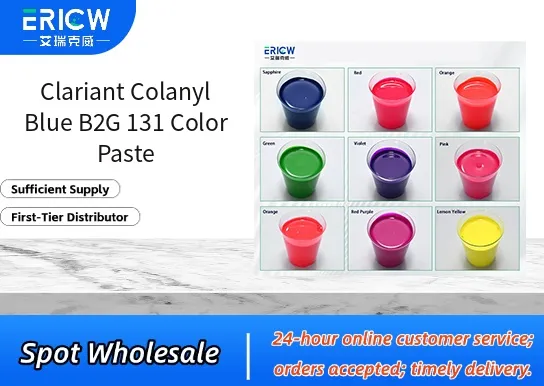
High chroma, clean phthalocyanine-based blue shade with excellent color strength.
Optimized for outstanding dispersion stability in water-based and solvent-based systems.
Good lightfastness and weather resistance suitable for demanding industrial applications.
Low volatile organic compound (VOC) content, supporting sustainable formulation goals.
Consistent batch-to-batch color reproducibility backed by Clariant’s quality control standards.
Architectural and industrial waterborne coatings.
Plastic coloration for polyolefins and PVC compounds.
Ink formulations for packaging gravure and flexographic printing.
Wood stains and transparent decorative finishes.
Specialty adhesives and sealants requiring stable blue hue.
| Chemical Type | Copper phthalocyanine pigment dispersion |
| Product Form | Liquid color paste |
| Appearance | Viscous, homogeneous blue paste |
| Primary Applications | Coatings, plastics, inks, wood finishes |
| Key Features | High tinctorial strength, low dusting, easy dispersibility |
| Benefits | Reduced mixing time, improved color consistency, compatibility with common resin systems |
| Recommended Carrier Base | Propylene glycol monomethyl ether / water blend |
| Storage Conditions | Store at 5–30 °C; protect from freezing and direct sunlight |
Q1: What types of polymer systems is Colanyl Blue B2G 131 compatible with?
A: Colanyl Blue B2G 131 is formulated for use in polyolefins—including polyethylene (PE) and polypropylene (PP)—as well as certain engineering thermoplastics. It demonstrates good thermal stability during standard melt processing conditions and is commonly used in injection molding, extrusion, and blow molding applications.
Q2: How should this color paste be incorporated into a polymer formulation?
A: The paste is typically added directly to the base polymer using standard masterbatch dilution or gravimetric feeding systems. For optimal dispersion, it is recommended to pre-mix with a portion of the carrier resin before full compounding. Avoid excessive shear or prolonged residence time at elevated temperatures to preserve color integrity.
Q3: Is Colanyl Blue B2G 131 suitable for food-contact applications?
A: This product is designed for industrial and non-food-contact applications unless explicitly approved under applicable regional food-contact regulations. Customers intending to use it in food-contact articles must verify compliance with local regulatory requirements and consult Clariant’s technical support for application-specific documentation.
Q4: What is the typical dosage range for achieving target shade intensity?
A: Dosage depends on the polymer type, desired depth of shade, and processing conditions. In most polyolefin applications, effective concentrations generally range from 0.1% to 2% by weight relative to the base resin—typically used at low concentrations due to its high tinting strength.
Contact With Us:
E-mail: wangxingqiang@ericwchem.com
Have a Questions? Call Us:
Add:
Building A1, Jiete Industrial Park, Huangpu District, Guangzhou City, Guangdong Province, China