English
 Español
 tiếng việt
 русский
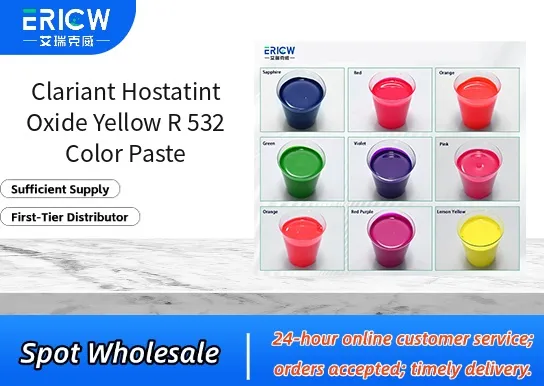
High chroma, clean oxide yellow shade with excellent lightfastness and weather resistance.
Optimized for low viscosity and superior dispersibility in aqueous and solvent-based systems.
Free of heavy metals and compliant with major global regulatory frameworks including REACH and RoHS.
Consistent batch-to-batch color reproducibility ensured by stringent Clariant quality control.
Designed for high thermal stability—retains color integrity during extrusion and compounding up to 220 °C.
Coloration of PVC profiles, pipes, and window frames.
Pigmenting rigid and flexible polyolefin compounds (PP, PE) for outdoor applications.
Coloring engineering plastics such as ABS and polycarbonate for automotive interior parts.
Use in architectural coatings requiring long-term UV stability and chalk resistance.
Functional coloring of masterbatches for construction materials including roofing membranes and geomembranes.
| Chemical Type | Inorganic iron oxide-based pigment dispersion |
| Product Form | Concentrated liquid color paste (water-based) |
| Appearance | Homogeneous, viscous yellow paste with slight gloss |
| Primary Applications | PVC, polyolefins, engineering plastics, architectural coatings |
| Key Features | Non-bleeding, heat-stable, low migration, REACH-compliant |
| Recommended Use Level | 0.5–3.0 wt% depending on substrate and required shade depth |
| Storage Stability | 12 months at 5–30 °C in sealed original container |
| Compatible Media | Aqueous systems, polar solvents, and PVC plastisols |
Q1: What types of polymers is Hostatint Oxide Yellow R 532 Color Paste compatible with?
A: This paste is specifically formulated for use in polyolefins (e.g., PP and PE), as well as engineering thermoplastics such as ABS, PS, and certain polyamides. It demonstrates good thermal stability and dispersion behavior during standard melt processing conditions.
Q2: Is this color paste suitable for food-contact applications?
A: Hostatint Oxide Yellow R 532 is designed for non-food-contact applications. It is not certified for direct or indirect food contact under major global regulatory frameworks unless explicitly validated by the end-user’s compliance process and supported by Clariant’s latest regulatory documentation.
Q3: How should this color paste be incorporated into polymer melts?
A: The paste is typically introduced via gravimetric or volumetric dosing systems directly into the extruder feed throat or hopper. Pre-blending with base resin prior to extrusion may improve homogeneity, especially at lower dosage levels.
Q4: Does this product contain heavy metals or restricted substances?
A: Hostatint Oxide Yellow R 532 is formulated without lead, cadmium, mercury, or hexavalent chromium, in alignment with Clariant’s commitment to responsible chemistry. It complies with RoHS and REACH SVHC criteria as applicable to colorants for plastics, subject to final formulation review.
Q5: What is the typical dosage range for achieving medium to strong yellow shades?
A: Dosage depends on the polymer matrix, required shade intensity, and processing conditions, but it is generally used at low concentrations—typically ranging from 0.1% to 2% by weight relative to the base polymer.
Contact With Us:
E-mail: wangxingqiang@ericwchem.com
Have a Questions? Call Us:
Add:
Building A1, Jiete Industrial Park, Huangpu District, Guangzhou City, Guangdong Province, China