English
 Español
 tiếng việt
 русский
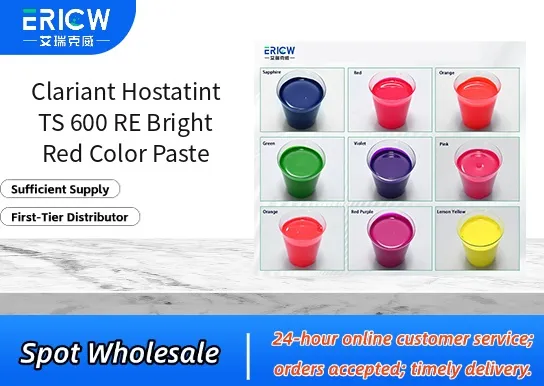
High chroma, intense bright red shade with excellent color strength and consistency.
Reactive dye-based formulation enabling superior wash and light fastness in cellulosic fibers.
Optimized rheology for easy handling, stable dispersion, and seamless integration into textile printing pastes.
RE (Restricted Substances Compliant) — meets Oeko-Tex® Standard 100 Class I and ZDHC MRSL v3.1 requirements.
Low migration tendency during steaming and fixation, ensuring sharp print definition and minimal bleeding.
Reactive screen printing on cotton, viscose, and blends.
Digital inkjet printing (with compatible pigment-reactive hybrid formulations).
Rotary and flatbed textile printing for fashion and home textiles.
High-end apparel and premium denim decoration requiring vivid reds and reliable reproducibility.
Technical textiles requiring colorfastness to washing, perspiration, and light exposure.
| Chemical Type | Reactive dye dispersion (monochlorotriazine type) |
| Product Form | Concentrated aqueous color paste |
| Appearance | Homogeneous, viscous red paste without sedimentation |
| pH (10% aqueous dispersion) | 6.5 – 7.5 |
| Heavy Metals | Compliant with EU Directive 2009/48/EC and CPSIA limits |
| Primary Applications | Textile reactive printing on cellulosics |
| Key Features | Bright red shade, high tinctorial strength, RE-compliant |
| Storage Stability | 12 months at 5–30 °C in sealed original container |
Q1: What is the primary application field for Hostatint TS 600 RE Bright Red Color Paste?
A: Hostatint TS 600 RE is specifically developed for coloring polyolefin-based packaging materials, including flexible films and rigid containers, where high chroma, excellent dispersion stability, and good thermal stability during processing are required.
Q2: Is this color paste suitable for food-contact applications?
A: Yes — Hostatint TS 600 RE is formulated with pigments and additives compliant with global food-contact regulations for polyolefins. Final compliance depends on the complete formulation, processing conditions, and end-use requirements, and users should verify suitability with their regulatory team.
Q3: How should Hostatint TS 600 RE be incorporated into polyolefin compounds?
A: It is typically added directly to the polymer melt during extrusion or injection molding. Good dispersion is achieved using standard compounding equipment; pre-mixing with a portion of the base resin is recommended for optimal homogeneity, especially at lower dosages.
Q4: Does this color paste exhibit resistance to migration in sealed packaging?
A: Yes — the pigment system and carrier matrix are engineered to minimize blooming and migration in polyolefin structures under typical storage conditions. Performance may vary depending on film thickness, sealing temperature, and contact media, so application-specific testing is advised.
Q5: What is the typical dosage range for achieving full opacity and vibrant red coloration?
A: Dosage generally ranges from 0.1% to 2% by weight, depending on the desired shade intensity, polymer type, and part thickness. For bright, opaque reds in thin films, concentrations toward the higher end of this range are often used, while translucent effects may require lower levels.
Contact With Us:
E-mail: wangxingqiang@ericwchem.com
Have a Questions? Call Us:
Add:
Building A1, Jiete Industrial Park, Huangpu District, Guangzhou City, Guangdong Province, China