English
 Español
 tiếng việt
 русский
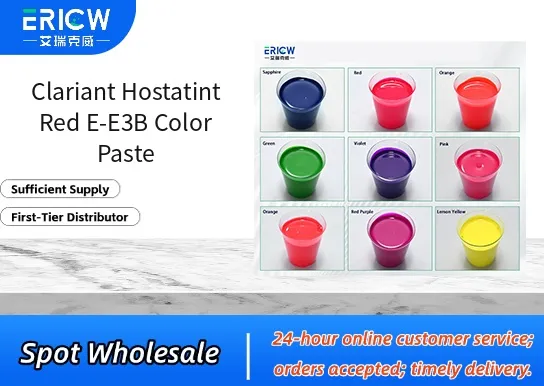
High chroma, intense red shade with excellent batch-to-batch color consistency.
Optimized for low migration and high lightfastness in demanding polymer applications.
Excellent thermal stability up to 260 °C, suitable for injection molding and extrusion processes.
Free of heavy metals and compliant with major global regulatory frameworks including FDA 21 CFR and EU Plastics Regulation (EU) No 10/2011.
Ready-to-use liquid paste formulation ensures easy dispersion and efficient dosing in masterbatch production.
Polypropylene (PP) and polyethylene (PE) packaging films and containers.
Rigid and flexible food-contact packaging requiring regulatory compliance.
Automotive interior components including dashboards and trim parts.
Household appliances and consumer electronics housings.
Medical device housings where color stability and biocompatibility support are critical.
| Chemical Type | Organic pigment dispersion (quinacridone-based) |
| Product Form | Liquid color paste (carrier: mineral oil & polymeric dispersant) |
| Appearance | Homogeneous, viscous red paste |
| Primary Applications | Polyolefins (PP, PE), engineering plastics (ABS, PS, PC blends) |
| Key Features | Low migration, high thermal stability, excellent dispersion efficiency |
| Benefits | Reduced processing time, consistent coloration, simplified masterbatch formulation |
| Regulatory Status | FDA 21 CFR §178.3297 compliant; EU Directive 2002/72/EC (as amended) |
| Storage Conditions | Store at 15–25 °C in sealed containers; protect from freezing and direct sunlight |
Q1: What types of polymer systems is Hostatint Red E-E3B Color Paste compatible with?
A: Hostatint Red E-E3B is specifically formulated for use in polyolefins (e.g., PP and PE), as well as certain engineering thermoplastics such as ABS and PS. It demonstrates good thermal stability during standard melt processing conditions and offers consistent dispersion without significant plate-out.
Q2: Is this color paste suitable for food-contact applications?
A: Hostatint Red E-E3B is designed for non-food-contact applications. It is not certified for direct or indirect food contact under major regulatory frameworks such as FDA 21 CFR or EU Framework Regulation (EC) No 1935/2004. For food-contact uses, Clariant offers dedicated, fully compliant pigment solutions upon request.
Q3: How should the paste be incorporated into a polymer formulation?
A: The paste is typically introduced via masterbatch dilution or direct addition to the base polymer during compounding. For optimal dispersion, pre-mixing with a portion of the carrier resin before extrusion is recommended. Dosage depends on formulation requirements but generally ranges from 0.1% to 2% by weight relative to the final compound.
Q4: Does Hostatint Red E-E3B offer UV resistance in outdoor applications?
A: While the pigment exhibits moderate lightfastness in typical indoor environments, it is not optimized for long-term UV exposure without additional stabilization. For demanding outdoor applications, we recommend pairing it with appropriate UV absorbers and HALS stabilizers to enhance durability.
Contact With Us:
E-mail: wangxingqiang@ericwchem.com
Have a Questions? Call Us:
Add:
Building A1, Jiete Industrial Park, Huangpu District, Guangzhou City, Guangdong Province, China