English
 Español
 tiếng việt
 русский
High chemical resistance to solvents, acids, and alkalis.
Excellent weathering and UV stability for long-term outdoor performance.
Low viscosity enabling easy processing and high solids formulation.
Good compatibility with melamine-formaldehyde and urea-formaldehyde crosslinkers.
Low volatile organic compound (VOC) content supporting sustainable coating systems.
Automotive OEM and refinish topcoats.
Industrial maintenance coatings for metal substrates.
Powder coatings requiring high gloss and mechanical durability.
Can coatings for food and beverage packaging.
Architectural coil coatings with stringent corrosion resistance requirements.
| Chemical Type | Saturated polyester resin |
| Product Form | Clear to pale yellow liquid |
| Appearance | Homogeneous, transparent liquid |
| Primary Applications | Thermosetting coatings (powder, coil, can, automotive) |
| Key Features | High crosslink density, low VOC, excellent flow and leveling |
| Benefits | Enhanced hardness, flexibility balance and substrate adhesion |
| Storage Stability | Stable under dry, cool conditions (≤30 °C); avoid freezing |
| Recommended Crosslinker | Melamine-formaldehyde resins (e.g., methylated types) |
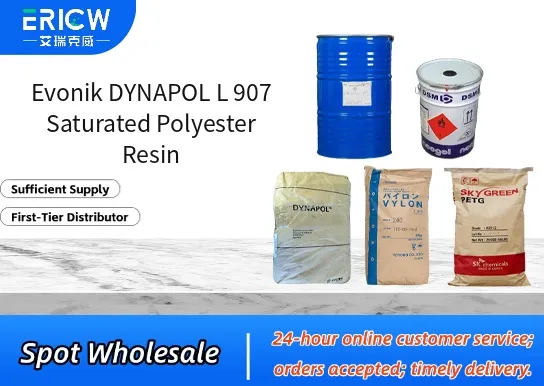
Q1: What is the primary application of DYNAPOL L 907 in coating systems?
A: DYNAPOL L 907 is a low-viscosity, saturated polyester resin designed primarily as a reactive diluent and rheology modifier in high-solids and solvent-free thermoset coatings—especially in coil, can, and general metal finishing applications where excellent flow, leveling, and crosslink density are required.
Q2: How does DYNAPOL L 907 contribute to film formation and cure performance?
A: It functions as a co-resin that enhances compatibility with common crosslinkers (e.g., melamine-formaldehyde and epoxy resins), improves melt viscosity control during baking, and supports rapid gelation and full network development without excessive volatility or yellowing.
Q3: Is DYNAPOL L 907 suitable for food-contact compliant coatings?
A: While DYNAPOL L 907 itself is not a finished food-contact coating, it has been successfully incorporated into formulations intended for incidental food contact—subject to final formulation validation and regulatory review by the coating manufacturer in accordance with applicable regional requirements.
Q4: What are the recommended storage conditions for optimal stability?
A: Store in original sealed containers in a cool, dry place away from direct sunlight and sources of heat. Prolonged exposure to elevated temperatures or moisture may affect viscosity and reactivity over time.
Contact With Us:
E-mail: wangxingqiang@ericwchem.com
Have a Questions? Call Us:
Add:
Building A1, Jiete Industrial Park, Huangpu District, Guangzhou City, Guangdong Province, China