English
 Español
 tiếng việt
 русский
High-gloss, durable film formation for premium aesthetic and protective performance.
Excellent compatibility with melamine formaldehyde crosslinkers for thermoset baking systems.
Good flow and leveling characteristics, supporting smooth, defect-free coatings.
Optimized acid value for balanced reactivity and pot life in industrial coil and appliance coatings.
Suitable for low-VOC formulations due to controlled volatile content and solvent blend design.
Coil coating topcoats for architectural and industrial metal substrates.
Appliance finishes for refrigerators, washing machines, and ovens.
Prefinished metal (PFM) coatings requiring high weather resistance and color retention.
General-purpose industrial maintenance coatings on steel and aluminum.
| Chemical Type | Saturated polyester resin |
| Product Form | Liquid, solvent-borne |
| Appearance | Clear to pale yellow, homogeneous liquid |
| Acid Value (mg KOH/g) | 28–34 |
| Hydroxyl Value (mg KOH/g) | 15–21 |
| Solids Content (% by weight) | 60 ± 1 |
| Density (g/cm³ at 25°C) | 1.08–1.12 |
| Viscosity (mPa·s at 25°C) | 3,500–5,500 |
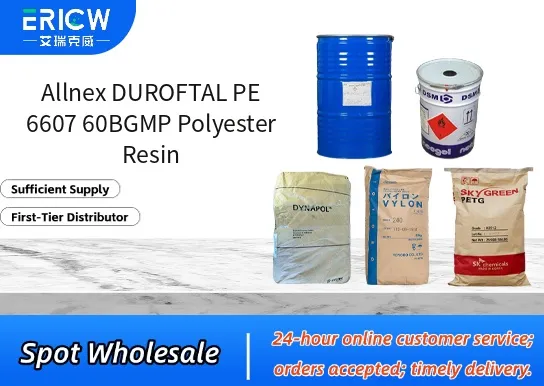
Q1: What is the primary application area for DUROFTAL PE 6607 60BGMP?
A: DUROFTAL PE 6607 60BGMP is a high-performance, low-viscosity unsaturated polyester resin specifically developed for solvent-free or low-solvent coil coating systems, where excellent flow, leveling, and cure response under rapid thermal conditions are required.
Q2: Is this resin suitable for food-contact applications?
A: DUROFTAL PE 6607 60BGMP is formulated with raw materials selected to support compliance with general food-contact regulations for coated metal substrates. However, final regulatory approval depends on the complete formulation, processing conditions, and end-use requirements — users must conduct full validation per applicable jurisdictional standards.
Q3: How does PE 6607 60BGMP differ from conventional coil coating polyesters?
A: Unlike standard coil coating polyesters, PE 6607 60BGMP offers enhanced reactivity and reduced melt viscosity, enabling faster cure profiles at lower peak metal temperatures while maintaining excellent film integrity and mechanical durability after curing.
Q4: What types of curing agents or accelerators are typically used with this resin?
A: This resin is designed for use with common peroxide initiators (e.g., di-tert-butyl peroxide or similar) and may be accelerated with cobalt or manganese naphthenates. Optimal selection and dosage depend on line speed, oven profile, and desired crosslink density — laboratory-scale optimization is recommended before full-scale implementation.
Contact With Us:
E-mail: wangxingqiang@ericwchem.com
Have a Questions? Call Us:
Add:
Building A1, Jiete Industrial Park, Huangpu District, Guangzhou City, Guangdong Province, China