English
 Español
 tiếng việt
 русский
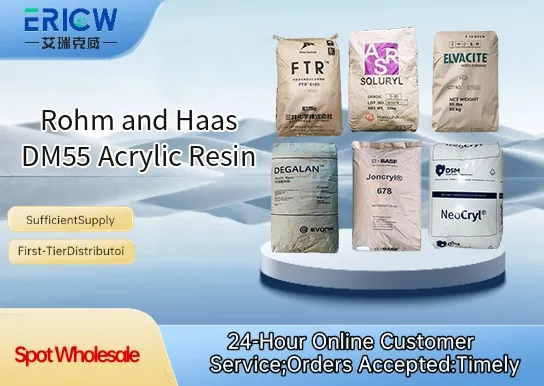
High solids content for improved formulation efficiency and reduced VOC emissions.
Excellent pigment wetting and dispersion stability in aqueous systems.
Good alkali resistance and scrub resistance for durable architectural coatings.
Balanced hardness-flexibility profile enabling crack-resistant dry films.
Low minimum film formation temperature (MFFT) for reliable coalescence at ambient conditions.
Interior and exterior architectural wall paints.
Low-VOC premium flat and eggshell finish coatings.
Primer-sealers for masonry, drywall, and plaster substrates.
Textured decorative coatings and elastomeric finishes.
Water-based industrial maintenance coatings for non-critical metal and concrete surfaces.
| Chemical Type | Acrylic copolymer emulsion |
| Product Form | Aqueous emulsion |
| Appearance | White to slightly bluish opaque liquid |
| Solids Content (wt%) | 54.0 – 56.0% |
| pH (at 25°C) | 8.0 – 9.0 |
| Minimum Film Formation Temperature (MFFT) | 12 – 14°C |
| Viscosity (Brookfield RVT, #2 spindle, 20 rpm, 25°C) | 500 – 1500 cP |
| Particle Size (D50) | 120 – 160 nm |
Q1: What is the primary function of DM55 in coating formulations?
A: DM55 is a waterborne acrylic associative thickener designed to provide efficient rheology control—particularly high-shear viscosity building and sag resistance—while maintaining good flow, leveling, and spatter resistance in architectural and industrial water-based coatings.
Q2: Is DM55 compatible with other rheology modifiers, such as cellulosic or non-associative thickeners?
A: Yes, DM55 is commonly used in combination with non-associative thickeners (e.g., HEC or alkali-swellable emulsions) to achieve balanced low-, mid-, and high-shear rheology. However, compatibility should be verified in the final formulation due to potential interactions with surfactants or other associative thickeners.
Q3: How should DM55 be incorporated into a water-based paint system?
A: DM55 is typically added during the let-down stage, after pigments and base thickeners, under moderate agitation. It is recommended to dilute with water or co-solvent prior to addition to ensure uniform dispersion and avoid localized over-thickening.
Q4: Does DM55 contribute to film formation or affect dry film properties?
A: As a rheology modifier, DM55 remains primarily in the aqueous phase and does not coalesce into the polymer film. It generally has minimal impact on final film integrity, gloss, or durability when used at typical dosage levels, though excessive use may influence water sensitivity or scrub resistance.
Q5: Can DM55 be used in low-VOC or zero-VOC formulations?
A: Yes, DM55 is supplied as a water-based dispersion with negligible VOC content and is widely utilized in low- and zero-VOC architectural and industrial coatings where regulatory compliance and environmental performance are key requirements.
Contact With Us:
E-mail: wangxingqiang@ericwchem.com
Have a Questions? Call Us:
Add:
Building A1, Jiete Industrial Park, Huangpu District, Guangzhou City, Guangdong Province, China