English
 Español
 tiếng việt
 русский
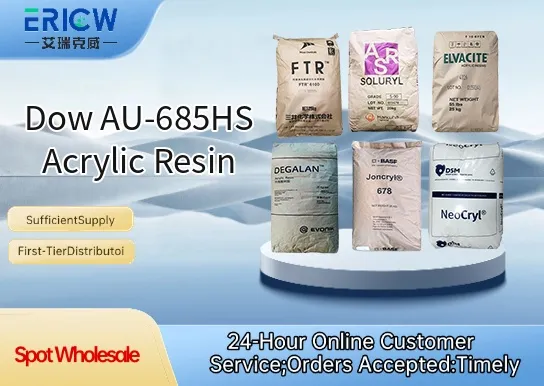
High-solids, low-VOC acrylic emulsion designed for sustainable coating formulations.
Excellent block resistance and early water resistance for fast-drying architectural and industrial coatings.
Superior scrub resistance and film integrity after curing, meeting ASTM D2486 requirements.
Good alkali resistance and compatibility with common coalescents and rheology modifiers.
Consistent batch-to-batch performance with robust freeze-thaw stability (3 cycles at –15 °C).
Interior and exterior architectural wall paints.
Low-odor, zero-VOC premium decorative coatings.
Industrial maintenance coatings for metal and masonry substrates.
Textured finishes and elastomeric wall systems.
Coatings requiring enhanced wet adhesion and humidity resistance.
| Chemical Type | Acrylic copolymer emulsion |
| Product Form | White to off-white liquid |
| Non-Volatile Content (wt%) | 52.0 ± 1.0% |
| pH | 8.0 – 9.0 |
| Particle Size (D50, nm) | 180 – 220 nm |
| Minimum Film Formation Temperature (MFFT) | 12 °C |
| Viscosity (Brookfield, mPa·s, RVT, #2 spindle, 20 rpm) | 50 – 150 |
| Freeze-Thaw Stability | Pass (3 cycles) |
Q1: What is the primary function of Dow AU-685HS Acrylic Resin in coating formulations?
A: Dow AU-685HS is a high-solids, solution-grade acrylic resin designed to serve as a film-forming binder that enhances gloss, clarity, and surface hardness in solvent-borne industrial and specialty coatings.
Q2: Is Dow AU-685HS compatible with common crosslinkers used in thermoset coatings?
A: Yes — it is formulated to be compatible with standard amino resins (e.g., melamine-formaldehyde) and isothermally reactive isocyanates, enabling robust cure response and improved chemical resistance in baked or ambient-cure systems.
Q3: How does AU-685HS contribute to VOC reduction in coating systems?
A: As a high-solids acrylic resin, AU-685HS allows formulators to achieve target viscosity and application properties with reduced solvent demand, supporting compliance with evolving low-VOC regulatory frameworks without compromising film performance.
Q4: Can AU-685HS be used in UV-curable hybrid systems?
A: While AU-685HS itself is not UV-reactive, it can be incorporated into hybrid UV/thermal systems as a non-volatile polymeric backbone to improve film build, flexibility, and intercoat adhesion — provided compatibility with photoinitiators and monomers is verified during formulation development.
Contact With Us:
E-mail: wangxingqiang@ericwchem.com
Have a Questions? Call Us:
Add:
Building A1, Jiete Industrial Park, Huangpu District, Guangzhou City, Guangdong Province, China