English
 Español
 tiếng việt
 русский
High thermal stability suitable for processing temperatures up to 1200 °C.
Excellent chemical resistance to acids, alkalis, and solvents in demanding industrial environments.
Consistent particle size distribution ensuring uniform color development and dispersion stability.
Non-toxic and compliant with major global regulatory frameworks for industrial pigments.
Low oil absorption enabling efficient formulation in high-solids and low-VOC systems.
Ceramic glazes and underglaze decorations for tableware and sanitaryware.
Architectural and industrial coatings requiring long-term weathering resistance.
Plastic coloration for exterior automotive components and construction profiles.
Specialty inks for heat-resistant labeling on metal and ceramic substrates.
Colored glass formulations for architectural and decorative glass products.
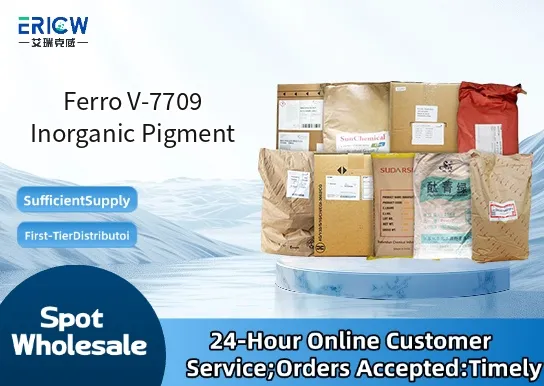
| Chemical Type | Mixed-metal oxide (Co–Cr–Al spinel-based) |
| Product Form | Free-flowing dry powder |
| Appearance | Dark bluish-green granular powder |
| Primary Applications | Ceramics, coatings, plastics, glass, inks |
| Key Features | Heat stability, lightfastness, pH neutrality |
| Benefits | Color consistency, low migration, non-volatile residue |
| Recommended Storage | Sealed container, cool and dry conditions |
| Regulatory Compliance | REACH registered; RoHS compliant; non-ELV restricted |
Q1: What is the primary chemical composition of Ferro V-7709?
A: Ferro V-7709 is a high-performance inorganic pigment based on a complex metal oxide system, engineered for thermal and chemical stability. Its exact formulation is proprietary, but it does not contain regulated heavy metals such as lead, cadmium, or hexavalent chromium.
Q2: Is Ferro V-7709 suitable for food-contact applications?
A: Ferro V-7709 is designed for industrial and decorative applications where regulatory compliance with food-contact standards is not required. It is not certified for direct food-contact use under FDA, EU, or other major food-safety frameworks. Customers requiring food-grade pigments should consult Ferro’s dedicated food-compliant product portfolio.
Q3: How does Ferro V-7709 perform under high-temperature processing conditions?
A: This pigment exhibits excellent thermal stability and retains its color integrity during standard polymer compounding and injection molding processes. It is formulated to withstand continuous exposure up to approximately 300 °C without significant degradation or gas evolution, making it suitable for engineering thermoplastics and high-heat coatings.
Q4: What dispersion methods are recommended for optimal performance in polymer systems?
A: For best results, Ferro V-7709 should be incorporated using high-shear melt compounding or masterbatch dilution. Pre-wetting with compatible carrier resins and controlled feeding into extruders help achieve uniform distribution. Avoid dry blending alone, as it may lead to agglomeration and inconsistent color development.
Q5: Can Ferro V-7709 be used in aqueous-based systems?
A: While primarily developed for solvent-borne and polymer applications, Ferro V-7709 can be adapted for aqueous dispersions with appropriate surface treatment and stabilization. Performance in water-based paints or inks depends heavily on pH control, dispersant selection, and shear history—formulation support from Ferro technical specialists is recommended.
Contact With Us:
E-mail: wangxingqiang@ericwchem.com
Have a Questions? Call Us:
Add:
Building A1, Jiete Industrial Park, Huangpu District, Guangzhou City, Guangdong Province, China