English
 Español
 tiếng việt
 русский
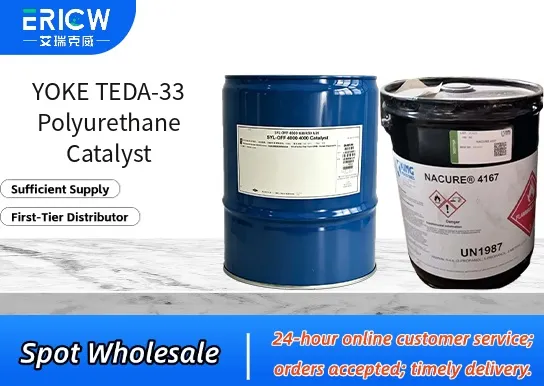
Highly efficient tertiary amine catalyst specifically optimized for flexible slabstock polyurethane foam production.
Excellent balance of cream, gel, and tack-free times for consistent foam cell structure and dimensional stability.
Low volatility and reduced odor profile compared to conventional DABCO®-type catalysts, supporting safer handling and improved workplace air quality.
Good compatibility with common polyol systems and low-reactivity isocyanates (e.g., MDI prepolymers), enabling formulation flexibility.
Stable performance across a broad temperature range (15–35 °C), minimizing batch-to-batch variability in industrial manufacturing.
Flexible molded and slabstock polyurethane foams for bedding and furniture.
Automotive interior foams including seat cushions, headrests, and armrests.
Carpet underlay and acoustic insulation foams requiring controlled rise kinetics.
Industrial packaging foams where consistent density distribution and surface integrity are critical.
Composite laminates and spray-applied foam systems utilizing slow-reacting polyol blends.
| Chemical Type | Tertiary amine catalyst (bis(2-dimethylaminoethyl)ether derivative) |
| Product Form | Liquid |
| Appearance | Clear, colorless to pale yellow liquid |
| Primary Applications | Flexible polyurethane foam (slabstock & molded) |
| Key Features | Fast cream time, balanced gelling, low volatility |
| Benefits | Improved processing window, reduced emissions, enhanced foam uniformity |
| Storage Stability | ≥12 months at 5–30 °C in sealed original container |
| Recommended Dosage | 0.05–0.30 pphp (parts per hundred polyol), depending on formulation |
Q1: What is the primary function of YOKE TEDA-33 in polyurethane systems?
A: YOKE TEDA-33 is a tertiary amine catalyst specifically designed to promote the urethane reaction (isocyanate–polyol coupling), enabling efficient gelation and improved cell structure control in flexible and semi-rigid foam formulations.
Q2: Is YOKE TEDA-33 suitable for low-emission or low-VOC applications?
A: Yes — YOKE TEDA-33 exhibits relatively low volatility and good compatibility with modern low-VOC formulation strategies. It contributes to reduced post-cure emissions compared to highly volatile alternatives, supporting compliance with evolving environmental and indoor air quality requirements.
Q3: How does YOKE TEDA-33 compare to standard TEDA (triethylenediamine) in terms of handling and stability?
A: YOKE TEDA-33 is a stabilized, liquid form of TEDA, offering enhanced storage stability and easier metering versus solid TEDA. Its homogeneous liquid state eliminates dust hazards and ensures consistent dispersion in polyol blends without pre-dissolution steps.
Q4: Can YOKE TEDA-33 be used in combination with other catalysts?
A: Yes — it is commonly paired with tin-based catalysts (e.g., dibutyltin dilaurate) or other amine catalysts to balance gelling and blowing reactions. Compatibility should be verified experimentally within the target formulation due to potential synergistic or inhibitory effects.
Q5: What is the typical dosage range for YOKE TEDA-33 in flexible slabstock foam?
A: Dosage is formulation-dependent, but it is generally used at low concentrations — typically ranging from 0.1% to 2.0% by weight relative to the polyol component — with optimization required based on desired cream time, rise profile, and final foam properties.
Contact With Us:
E-mail: wangxingqiang@ericwchem.com
Have a Questions? Call Us:
Add:
Building A1, Jiete Industrial Park, Huangpu District, Guangzhou City, Guangdong Province, China