English
 Español
 tiếng việt
 русский
Enhanced thermal stability due to controlled silicone incorporation for improved high-temperature performance.
Excellent weather resistance and UV durability, significantly extending coating service life in outdoor exposure.
Good compatibility with melamine formaldehyde crosslinkers, enabling robust thermoset network formation.
Balanced flexibility and hardness, supporting crack resistance without sacrificing mechanical integrity.
Low volatile organic compound (VOC) content, supporting compliance with stringent environmental regulations.
Prefabricated metal roofing and wall panel coatings.
Appliance exterior finishes (e.g., refrigerators, washing machines).
Automotive under-hood components requiring thermal resilience.
Industrial coil coatings for architectural and structural steel.
High-performance general industrial maintenance coatings.
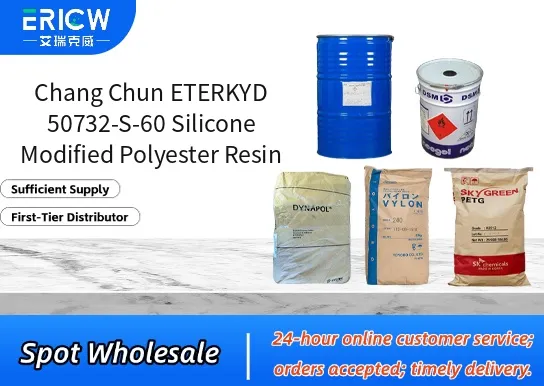
| Chemical Type | Silicone-modified polyester resin |
| Product Form | Liquid, solvent-based |
| Appearance | Clear to pale yellow transparent liquid |
| Primary Applications | Thermosetting coil and can coatings, high-durability industrial finishes |
| Key Features | Thermal stability, UV resistance, crosslinker compatibility, low VOC |
| Recommended Crosslinker | High-aminoplast (e.g., hexamethoxymethylmelamine) |
| Storage Stability | ≥12 months at 25°C in sealed original container |
| Flash Point (Tag Closed Cup) | Approx. 45–50°C |
Q1: What are the primary benefits of silicone modification in this polyester resin?
A: The silicone modification enhances thermal stability, improves surface hydrophobicity and mar resistance, and contributes to better film flexibility and weatherability compared to conventional polyester resins—making it especially suitable for high-performance coil coating and exterior architectural applications.
Q2: Is ETERKYD 50732-S-60 compatible with common crosslinkers used in thermosetting coatings?
A: Yes, it is formulated to react efficiently with standard amino crosslinkers such as melamine-formaldehyde resins, and shows good compatibility with blocked isocyanates in two-component polyurethane systems—enabling versatile curing options across baking and ambient-cure formulations.
Q3: How does this resin perform in UV-exposed outdoor applications?
A: Due to its silicone-modified backbone, ETERKYD 50732-S-60 exhibits improved resistance to UV degradation and chalking versus unmodified polyesters, supporting long-term gloss retention and color stability in demanding exterior coil and metal façade coatings.
Q4: Can this resin be used in low-VOC or high-solids coating systems?
A: Yes—it is designed for formulation flexibility and performs well in medium-to-high solids solventborne systems; when combined with appropriate solvents and rheology modifiers, it supports VOC reduction strategies without compromising flow, leveling, or cure response.
Contact With Us:
E-mail: wangxingqiang@ericwchem.com
Have a Questions? Call Us:
Add:
Building A1, Jiete Industrial Park, Huangpu District, Guangzhou City, Guangdong Province, China