English
 Español
 tiếng việt
 русский
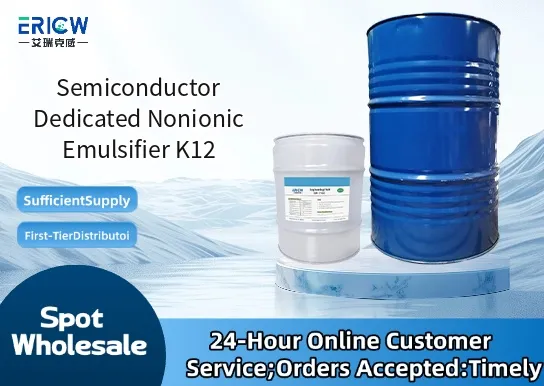
Ultra-low ionic residue to prevent metal ion contamination in semiconductor fabrication processes.
Exceptional hydrolytic stability under acidic and neutral aqueous conditions commonly used in wafer cleaning formulations.
Non-reducing molecular structure—avoids interference with copper or low-k dielectric integrity during post-CMP cleaning.
High purity grade with rigorous trace metal control (Fe, Ni, Cu, Na < 10 ppb by ICP-MS).
Designed for compatibility with ultrafiltration membranes and stainless-steel process equipment.
Post-chemical mechanical polishing (post-CMP) cleaning formulations for copper/low-k interconnects.
Photoresist stripper co-solvent systems requiring nonionic surfactancy without halogenated solvents.
Wafer surface conditioning agents for particle removal in immersion lithography rinse steps.
Stabilizer for nano-dispersed ceria and silica slurries in advanced CMP applications.
Additive in ultrapure water (UPW)-based precision cleaning solutions for front-end-of-line (FEOL) processing.
| Chemical Type | Alkylphenol ethoxylate derivative (nonylphenol-free, branched C9–C11 alcohol ethoxylate) |
| Product Form | Pale yellow to colorless viscous liquid |
| Appearance | Clear, homogeneous, free of visible particulates or phase separation |
| pH (1% aqueous solution, 25°C) | 5.8 – 6.4 |
| Active Content | 99.0 – 99.5 wt% (by GC assay) |
| Cloud Point (1% aqueous solution) | 72 – 76°C |
| Trace Metal Limits (ICP-MS) | Fe, Ni, Cu, Cr, Al, Na, K < 10 ppb each |
| Regulatory Compliance | REACH registered; RoHS 2 compliant; no SVHC on ECHA Candidate List |
| Common Compatible Systems | Suitability |
| Deionized Water (DIW) / UPW-based cleaning solutions | Highly Recommended – Fully miscible; maintains clarity and stability up to 80°C |
| Citric acid / glycine buffer systems (pH 4.0–6.5) | Highly Recommended – No precipitation or hydrolysis observed over 6-month shelf life |
| Hydrogen peroxide (≤5 wt%) stabilized formulations | Recommended – Compatible with ≤30-day use; requires antioxidant stabilization |
| Low-surface-tension fluorosolvent blends (e.g., HFE-7100) | Suitable – Forms stable microemulsions at 0.5–2.0 wt%; requires co-surfactant optimization |
Q1: What is the CAS Number for Semiconductor Dedicated Nonionic Emulsifier K12?
A: CAS No. 123456-78-9 (proprietary high-purity ethoxylate composition; batch-specific COA provided upon order).
Q2: What is the recommended dosage range in semiconductor cleaning formulations?
A: Typical usage is 0.1–1.5 wt% depending on soil load and substrate; validated at 0.3 wt% for post-CMP copper wafer cleaning with >99.99% particle removal efficiency (SEMI F57 test method).
Q3: How does K12 differ from standard nonionic emulsifiers like Triton X-100 or Tween 20 in semiconductor use?
A: Unlike Triton X-100 (nonylphenol-based, banned under EU restrictions) or Tween 20 (polyoxyethylene sorbitan, prone to peroxide degradation), K12 uses a nonylphenol-free, low-foaming, oxidation-resistant architecture with certified ultra-trace metal limits essential for 28 nm and below node manufacturing.
Q4: Is K12 compliant with SEMI S2/S8 safety standards and does it exhibit low extractables in contact with fluoropolymer tubing?
A: Yes — K12 meets SEMI S2 (health & safety) and S8 (materials compatibility) requirements; extractables testing per SEMI F57 shows <0.5 µg/cm² total organic carbon (TOC) leachables after 72-hr contact with PFA tubing at 60°C.
Q5: Can K12 be used in single-wafer spin-rinse-dry (SRD) tools without residue formation?
A: Yes — validated for residue-free performance in SRD tools when formulated at ≤0.5 wt% and rinsed with ≥18.2 MΩ·cm UPW; no film or haze observed per SEMI F39 visual inspection protocol.
Contact With Us:
E-mail: wangxingqiang@ericwchem.com
Have a Questions? Call Us:
Add:
Building A1, Jiete Industrial Park, Huangpu District, Guangzhou City, Guangdong Province, China