English
 Español
 tiếng việt
 русский
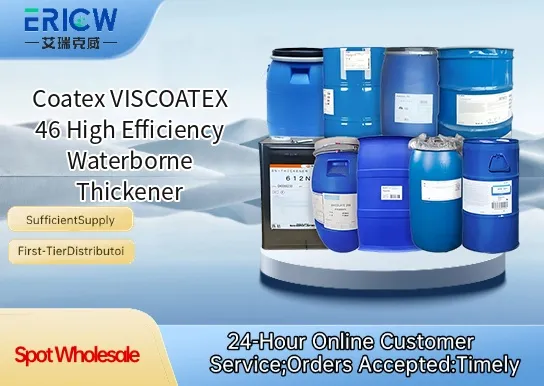
High-efficiency associative thickening with excellent rheology control in low-VOC and zero-VOC formulations.
Outstanding compatibility with acrylic, vinyl acetate, and styrene-acrylic latex systems.
Provides superior sag resistance and leveling balance without compromising brushability or spray atomization.
Low foaming profile—minimizes foam generation during high-shear mixing and application.
pH-stable performance across broad pH range (6.0–10.0), ensuring consistent viscosity build-up.
Architectural interior and exterior waterborne paints.
Waterborne wood coatings including primers, topcoats, and clear finishes.
Industrial maintenance coatings for metal and concrete substrates.
Water-based adhesives and construction sealants requiring shear-thinning behavior.
Emulsion-based grouts and tile adhesives.
| Chemical Type | Hydrophobically modified ethoxylated urethane (HEUR) |
| Product Form | Liquid concentrate |
| Appearance | Opaque white to off-white viscous liquid |
| pH (1% aqueous solution) | 7.0–8.5 |
| Active Content | 30–32 wt% |
| Density (20°C) | 1.04–1.07 g/cm³ |
| Viscosity (Brookfield RVT, spindle #3, 20 rpm, 25°C) | 15,000–25,000 mPa·s |
| Primary Applications | Waterborne architectural and industrial coatings, adhesives, sealants |
Q1: What type of rheology does VISCOATEX 46 provide in waterborne systems?
A: VISCOATEX 46 delivers pronounced pseudoplastic (shear-thinning) behavior with strong high-shear viscosity control and effective sag resistance, making it especially suitable for architectural coatings, industrial finishes, and waterborne inks requiring balanced flow and leveling.
Q2: How is VISCOATEX 46 typically incorporated into formulations?
A: It is generally added during the let-down stage, either directly or pre-diluted in water. Good mechanical agitation is recommended to ensure uniform dispersion and full hydration; incorporation at moderate pH (7–9) supports optimal thickening performance.
Q3: Is VISCOATEX 46 compatible with common co-thickeners and additives?
A: Yes — it shows good compatibility with associative thickeners (e.g., HEUR, HASE), cellulose ethers, and most standard surfactants, defoamers, and biocides used in waterborne coatings. Synergistic effects are often observed when combined with hydrophobically modified polymers.
Q4: Does VISCOATEX 46 affect film formation or gloss in finished coatings?
A: When used within typical dosage ranges, it has minimal impact on film clarity, gloss retention, or intercoat adhesion. Its non-ionic nature and low residue profile help maintain optical properties and substrate compatibility across diverse binder systems.
Q5: What storage conditions are recommended for optimal shelf life?
A: Store in original sealed containers at temperatures between 5 °C and 30 °C, away from direct sunlight and freezing conditions. Under these conditions, the product maintains consistent performance for up to 12 months from date of manufacture.
Contact With Us:
E-mail: wangxingqiang@ericwchem.com
Have a Questions? Call Us:
Add:
Building A1, Jiete Industrial Park, Huangpu District, Guangzhou City, Guangdong Province, China