English
 Español
 tiếng việt
 русский
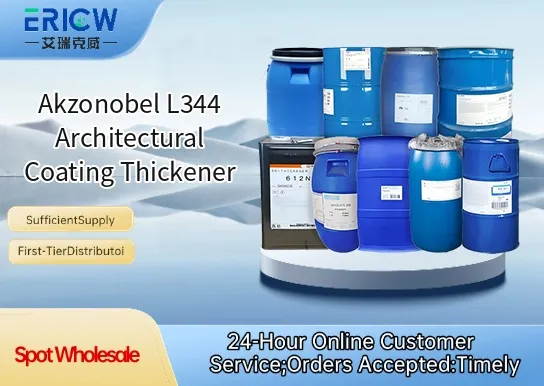
Non-ionic associative thickener delivering excellent rheology control in waterborne architectural coatings.
Provides outstanding sag resistance and leveling balance without compromising brushability or spray performance.
Highly compatible with common surfactants, co-thickeners, and pigment dispersions in acrylic and vinyl-acrylic systems.
Delivers consistent viscosity stability across varying pH ranges (pH 7–10) and storage conditions.
Low foaming profile supports efficient high-shear manufacturing and application processes.
Interior and exterior flat and low-sheen wall paints.
Textured decorative coatings and elastomeric finishes.
Primer-sealers for masonry and drywall substrates.
Low-VOC and zero-VOC compliant architectural paint formulations.
Ready-mixed retail and professional-grade coating systems.
| Chemical Type | Non-ionic associative polyurethane thickener |
| Product Form | Aqueous dispersion |
| Appearance | Opaque white to off-white liquid |
| pH (1% aqueous solution) | 7.0–8.5 |
| Active Content | 25–27 wt% |
| Viscosity (Brookfield, 25°C, spindle #3, 20 rpm) | 1,500–3,500 cP |
| Freeze-Thaw Stability | Passes 3 cycles (−18°C/24 h → 23°C/24 h) |
| Primary Applications | Architectural waterborne coatings requiring balanced flow and anti-sag performance |
Q1: What type of rheology does L344 provide in architectural coatings?
A: L344 is a hydrophobically modified ethoxylated urethane (HEUR) thickener that delivers strong pseudoplastic rheology—providing excellent sag resistance during application while maintaining good flow and leveling after brushing or rolling.
Q2: Is L344 compatible with both water-based latex and acrylic emulsion systems?
A: Yes, L344 is specifically designed for use in waterborne architectural coatings, including styrene-acrylic, pure acrylic, and vinyl-acrylic emulsions. It exhibits good compatibility across a broad pH range (typically pH 7–10) and minimal sensitivity to common electrolytes found in formulation.
Q3: How should L344 be incorporated into a coating formulation?
A: L344 is typically added during the let-down stage, after pigment dispersion and under moderate agitation. Pre-dilution with water or co-solvent (e.g., propylene glycol) is recommended to ensure uniform distribution and avoid localized overdosing. Avoid high-shear addition directly to concentrated polymer phases.
Q4: Does L344 contribute to film formation or affect final coating properties?
A: As a non-film-forming rheology modifier, L344 remains dispersed in the aqueous phase and does not participate in the coalescence or film-building process. It has no significant impact on gloss, scrub resistance, or adhesion when used at typical dosage levels.
Q5: Can L344 be used in low-VOC or zero-VOC formulations?
A: Yes—L344 contains no added APEOs, formaldehyde, or volatile organic solvents, making it suitable for low- and zero-VOC architectural coating systems compliant with major regional environmental guidelines.
Contact With Us:
E-mail: wangxingqiang@ericwchem.com
Have a Questions? Call Us:
Add:
Building A1, Jiete Industrial Park, Huangpu District, Guangzhou City, Guangdong Province, China