English
 Español
 tiếng việt
 русский
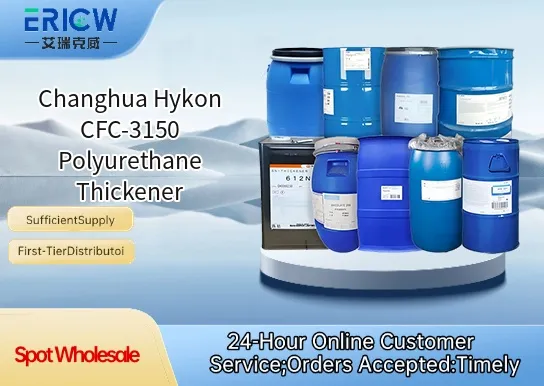
Non-ionic, associative rheology modifier for waterborne polyurethane dispersions.
Delivers excellent low-shear viscosity build and outstanding sag resistance.
Provides superior compatibility with acrylics, vinyl acetate, and PU-based systems.
Enables stable viscosity performance across broad pH range (pH 4–10).
Low foaming profile ensures smooth application and minimal surface defects.
Architectural interior wall paints and coatings.
Industrial maintenance coatings for metal and concrete substrates.
Wood finishing systems including waterborne varnishes and stains.
Automotive refinish clearcoats and basecoats.
High-performance floor coatings and epoxy-modified PU sealers.
| Chemical Type | Non-ionic polyurethane associative thickener |
| Product Form | Aqueous dispersion |
| Appearance | Opaque white to off-white liquid |
| pH (1% aqueous solution) | 6.5–7.5 |
| Solids Content | 25.0 ± 1.0 wt% |
| Viscosity (Brookfield RVT, #2 spindle, 20 rpm, 25°C) | 800–1,200 cP |
| Freeze-Thaw Stability | Pass (3 cycles at –5°C/25°C) |
| Primary Applications | Waterborne polyurethane and hybrid coating systems |
Q1: What type of rheology does CFC-3150 provide in polyurethane systems?
A: CFC-3150 is a non-ionic, associative polyurethane thickener that delivers pronounced shear-thinning behavior and excellent sag resistance, with good recovery after shear—ideal for coatings and sealants requiring balanced application and vertical hold.
Q2: Is CFC-3150 compatible with anionic surfactants and common co-thickeners?
A: Yes, CFC-3150 exhibits broad compatibility with anionic surfactants, cellulose ethers, and acrylic thickeners, though pre-testing is recommended when combining with high-ionic-strength additives or strongly cationic components to avoid potential viscosity instability.
Q3: How should CFC-3150 be incorporated into waterborne PU formulations?
A: It is typically added during the post-addition stage—after primary dispersion and pH adjustment—under moderate agitation. Pre-dilution with water or a compatible solvent may aid uniform dispersion, especially in low-shear processes.
Q4: Does CFC-3150 contribute to film formation or affect final coating properties?
A: As a non-volatile rheology modifier, CFC-3150 remains in the dry film and may influence surface feel and intercoat adhesion; however, it does not act as a film former. Its impact on gloss, hardness, or flexibility is formulation-dependent and generally minimal at typical use levels.
Q5: What storage conditions are recommended for optimal shelf life?
A: Store in original sealed containers at temperatures between 5°C and 35°C, away from direct sunlight and freezing conditions. Prolonged exposure to extreme heat or moisture may affect viscosity stability and performance consistency.
Contact With Us:
E-mail: wangxingqiang@ericwchem.com
Have a Questions? Call Us:
Add:
Building A1, Jiete Industrial Park, Huangpu District, Guangzhou City, Guangdong Province, China