English
 Español
 tiếng việt
 русский
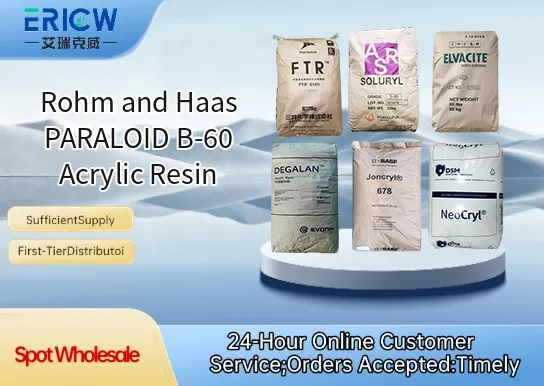
High-gloss, durable film-forming acrylic resin for solvent-based coatings.
Excellent compatibility with nitrocellulose, CAB, and other common coating resins.
Superior clarity and color stability under UV exposure and thermal aging.
Good flow and leveling characteristics for high-quality decorative finishes.
Low solution viscosity enables high-solids formulation without sacrificing application performance.
Automotive refinish clearcoats and basecoats.
Industrial wood coatings for furniture and cabinetry.
Plastic coatings for ABS, PC, and PVC substrates.
General-purpose protective and decorative solvent-borne topcoats.
| Chemical Type | Acrylic copolymer |
| Product Form | Free-flowing white to off-white granular solid |
| Appearance (10% in Toluene) | Clear, colorless to pale yellow solution |
| Primary Applications | Solvent-borne clearcoats, basecoats, and plastic coatings |
| Key Features | High gloss, excellent compatibility, UV stability, low viscosity in solution |
| Benefits | Enhanced durability, ease of formulation, improved finish aesthetics |
| Solubility | Soluble in aromatic hydrocarbons, ketones, esters, and chlorinated solvents |
| Storage Stability | Stable at ambient temperature for ≥12 months in original sealed container |
Q1: What is the primary function of PARALOID B-60 in coating formulations?
A: PARALOID B-60 is a thermoplastic acrylic resin primarily used as a performance modifier to enhance gloss, clarity, hardness, and mar resistance in solvent-borne and high-solids coatings—especially for automotive refinish, industrial maintenance, and plastic substrates.
Q2: Is PARALOID B-60 compatible with common crosslinkers used in OEM or refinish coatings?
A: Yes, PARALOID B-60 demonstrates good compatibility with melamine-formaldehyde resins, urethane crosslinkers, and other amino resins commonly employed in thermosetting systems. Compatibility should always be confirmed experimentally within the specific formulation matrix.
Q3: How does PARALOID B-60 affect film formation and drying behavior?
A: As a non-reactive thermoplastic resin, PARALOID B-60 contributes to improved flow, leveling, and early-stage film integrity without participating in cure chemistry. It typically reduces solvent retention and supports faster physical drying, though final cure speed remains governed by the reactive binder system.
Q4: Can PARALOID B-60 be used in low-VOC or high-solids applications?
A: Yes—its high molecular weight and favorable solubility in common mid- and slow-evaporating solvents make it well-suited for high-solids formulations. It helps maintain viscosity control and film quality while supporting VOC reduction strategies, provided solvent selection aligns with regulatory and processing requirements.
Contact With Us:
E-mail: wangxingqiang@ericwchem.com
Have a Questions? Call Us:
Add:
Building A1, Jiete Industrial Park, Huangpu District, Guangzhou City, Guangdong Province, China