English
 Español
 tiếng việt
 русский
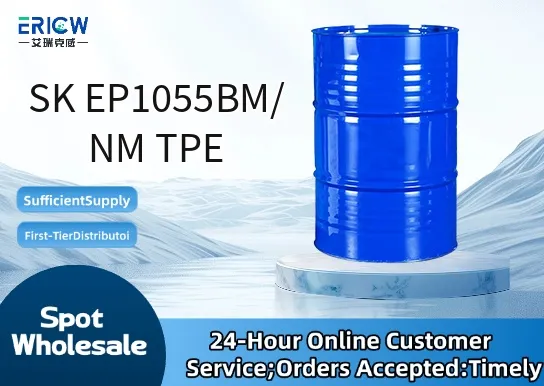
Excellent soft-touch feel with balanced elasticity and recovery performance.
Good processability on standard injection molding and extrusion equipment.
Enhanced compatibility with polypropylene (PP) and polyethylene (PE) substrates for overmolding.
Low extractables and compliant with FDA 21 CFR §177.2600 for food-contact applications.
UV-stabilized formulation offering improved resistance to discoloration under ambient light exposure.
Soft-grip overmolded handles for power tools and garden equipment.
Sealing components in household appliances and water dispensers.
Ergonomic grips for medical device housings and diagnostic instruments.
Flexible hinges and snap-fit parts in consumer electronics enclosures.
Food-grade squeeze bottles and reusable kitchen accessories.
| Chemical Type | Thermoplastic Elastomer (TPE) – Styrenic Block Copolymer (SBC) based |
| Product Form | Pellets |
| Appearance | Off-white, translucent granules |
| Hardness (Shore A) | 55 ± 3 |
| Melt Flow Rate (230°C/2.16 kg) | 18–22 g/10 min |
| Density | 0.90–0.92 g/cm³ |
| Key Features | Soft-touch, PP/PE adhesion, low odor, non-toxic |
| Compliance | RoHS 2011/65/EU, REACH SVHC-free, FDA 21 CFR §177.2600 |
Q1: What is the primary functional role of SK EP1055BM/NM TPE in polymer formulations?
A: SK EP1055BM/NM TPE is a thermoplastic elastomer designed primarily as a compatibilizer and impact modifier, especially for polyolefin-based blends. It enhances interfacial adhesion between immiscible polymers and improves toughness without significantly compromising melt processability.
Q2: Is SK EP1055BM/NM TPE suitable for applications requiring regulatory compliance with food contact or medical device standards?
A: While SK EP1055BM/NM TPE is formulated with non-toxic, low-extractable components, formal regulatory clearance (e.g., FDA, EU food contact, or ISO 10993) must be verified on a case-by-case basis depending on final formulation, processing conditions, and end-use requirements. Customers are advised to conduct application-specific testing and consult local regulatory guidance.
Q3: How does SK EP1055BM/NM TPE perform under thermal processing conditions typical for injection molding or extrusion?
A: This grade exhibits good thermal stability up to standard polyolefin processing temperatures (typically below 230 °C), with minimal degradation or volatilization. It maintains consistent rheological behavior across common shear rates and shows excellent dispersion in molten polymer matrices when properly compounded.
Q4: Can SK EP1055BM/NM TPE be used in combination with other elastomers or fillers?
A: Yes — it is compatible with common polyolefin elastomers (e.g., POEs, EPDM-based TPEs) and widely used mineral fillers such as calcium carbonate and talc. Synergistic effects on stiffness-toughness balance have been observed in multi-component systems, though optimal loading ratios depend on the base resin and target performance profile.
Contact With Us:
E-mail: wangxingqiang@ericwchem.com
Have a Questions? Call Us:
Add:
Building A1, Jiete Industrial Park, Huangpu District, Guangzhou City, Guangdong Province, China