English
 Español
 tiếng việt
 русский
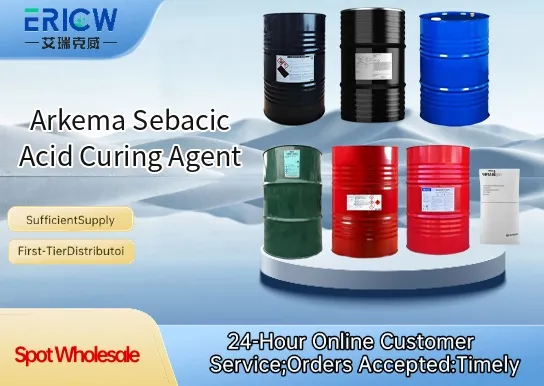
High-purity sebacic acid-based curing agent for enhanced epoxy network stability.
Enables flexible, impact-resistant cured films with excellent low-temperature performance.
Low volatility and low odor profile—ideal for indoor and sensitive application environments.
Improved hydrolytic stability compared to conventional aliphatic diacid curing agents.
Compatible with standard epoxy resins (e.g., DGEBA) without requiring catalysts or accelerators.
Flexible epoxy coatings for concrete flooring and industrial maintenance.
Electrical encapsulation compounds requiring thermal cycling resistance.
Adhesives for composites in automotive interior and lightweight structural bonding.
UV-curable hybrid epoxy systems where post-cure flexibility is critical.
Marine-grade protective coatings exposed to humidity and salt environments.
| Chemical Type | Aliphatic dicarboxylic acid derivative |
| Product Form | White crystalline solid |
| Appearance | Free-flowing granular powder |
| Molecular Weight (approx.) | 202 g/mol |
| Melting Range | 130–134 °C |
| Acid Value | 550–565 mg KOH/g |
| Moisture Content (max) | 0.2 wt% |
| Primary Applications | Epoxy resin curing for flexible coatings, adhesives, and encapsulants |
Q1: What is the primary function of Arkema Sebacic Acid Curing Agent in epoxy systems?
A: It serves as a reactive curing agent for epoxy resins, enabling crosslinking at ambient or moderately elevated temperatures to form thermoset networks with enhanced flexibility, hydrolytic stability, and reduced brittleness compared to conventional amine-based hardeners.
Q2: Is this curing agent suitable for food-contact or potable water applications?
A: While sebacic acid derivatives are recognized for low toxicity and good regulatory acceptance in certain polymer contexts, final compliance for food-contact or drinking water applications depends on full system formulation, processing conditions, and regional regulatory evaluation — users must conduct appropriate testing and verification per applicable local requirements.
Q3: How does humidity affect the cure performance of this agent?
A: Unlike moisture-sensitive anhydrides or some amines, sebacic acid-based curing agents exhibit relatively low sensitivity to ambient humidity during mixing and initial cure, supporting more robust processing in variable environmental conditions — though excessive moisture may still influence final network density and surface quality.
Q4: Can it be blended with other curing agents to modify performance?
A: Yes, it is commonly co-formulated with complementary hardeners — such as aliphatic amines or polyamides — to balance reactivity, flexibility, and chemical resistance; compatibility and stoichiometric adjustments should be confirmed experimentally for each specific resin system.
Contact With Us:
E-mail: wangxingqiang@ericwchem.com
Have a Questions? Call Us:
Add:
Building A1, Jiete Industrial Park, Huangpu District, Guangzhou City, Guangdong Province, China