English
 Español
 tiếng việt
 русский
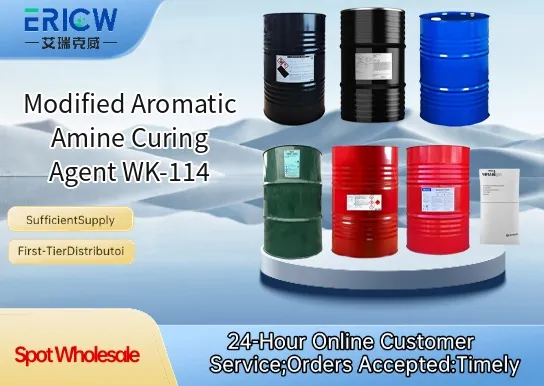
Enhanced reactivity with epoxy resins at ambient and low temperatures (down to 5°C).
Improved flexibility and impact resistance in cured epoxy systems without sacrificing thermal stability.
Low viscosity (< 800 mPa·s at 25°C) enabling easy metering, mixing, and improved filler wetting.
Reduced volatility and amine odor compared to conventional aromatic amines, supporting safer handling.
Excellent chemical resistance — particularly to alkalis, solvents, and mild acids in protective coatings.
High-performance epoxy flooring systems for industrial and commercial facilities.
Structural adhesives requiring fast development of handling strength at ambient conditions.
Anti-corrosive primers and topcoats for steel infrastructure and marine environments.
Electrical encapsulation and potting compounds demanding low exotherm and dimensional stability.
Repair mortars and grouts where rapid cure and early load-bearing capacity are critical.
| Chemical Type | Modified aromatic polyamine |
| Product Form | Liquid |
| Appearance | Pale yellow to amber clear liquid |
| Viscosity (25°C) | 600–800 mPa·s |
| Density (25°C) | 1.08–1.12 g/cm³ |
| Amine Value | 380–420 mg KOH/g |
| Reactivity (with DGEBA epoxy) | Gel time: 35–50 min at 25°C; Full cure: 7 days at 25°C |
| Storage Stability | ≥12 months in sealed container at 15–25°C |
Q1: What is the primary functional advantage of WK-114 compared to conventional aromatic amine curing agents?
A: WK-114 offers improved latency and reduced volatility while retaining high reactivity toward epoxy resins, enabling better pot life control and safer handling without compromising final crosslink density or thermal performance.
Q2: Is WK-114 suitable for use in coatings requiring FDA-compliant food-contact approval?
A: WK-114 is not pre-approved for direct food-contact applications; its suitability depends on full formulation evaluation and regulatory review by the end-user. It may be considered for indirect contact systems where migration is rigorously controlled and validated.
Q3: How does WK-114 perform in low-temperature cure applications?
A: WK-114 demonstrates reliable reactivity at ambient to moderately elevated temperatures (e.g., 15–40 °C), supporting efficient cure development without forced heating—though full property development may benefit from a mild post-cure step depending on film thickness and substrate.
Q4: Can WK-114 be used with standard bisphenol-A and bisphenol-F epoxy resins?
A: Yes, WK-114 is broadly compatible with common liquid and solid bisphenol-based epoxy resins, as well as novolac epoxies, and typically delivers good adhesion, chemical resistance, and mechanical integrity across these systems.
Q5: What safety precautions should be observed during handling and storage?
A: As with all aromatic amines, avoid skin contact and inhalation of dust or vapor. Use appropriate PPE—including nitrile gloves, eye protection, and respiratory protection if aerosol generation is possible. Store in tightly sealed containers under dry, cool conditions away from strong oxidizers.
Contact With Us:
E-mail: wangxingqiang@ericwchem.com
Have a Questions? Call Us:
Add:
Building A1, Jiete Industrial Park, Huangpu District, Guangzhou City, Guangdong Province, China