English
 Español
 tiếng việt
 русский
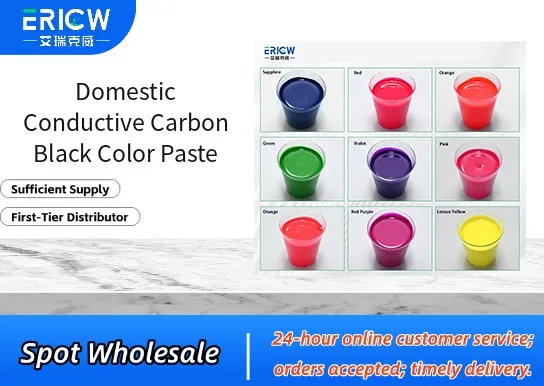
Highly stable conductive network formation in polymer matrices without compromising color consistency.
Optimized particle dispersion for low viscosity and excellent shear stability during processing.
Low volatile organic compound (VOC) content, compliant with industrial environmental safety standards.
Consistent batch-to-batch performance ensured through rigorous in-house quality control and carbon black surface treatment.
Compatible with common thermoplastics including polyethylene, polypropylene, and ABS.
Antistatic packaging films for electronics and pharmaceutical industries.
Conductive components in automotive interior parts requiring ESD protection.
Static-dissipative flooring compounds and industrial mats.
EMI shielding housings for consumer electronics enclosures.
Conductive masterbatches for wire & cable jacketing applications.
| Chemical Type | Carbon black-based conductive pigment dispersion |
| Product Form | Viscous liquid paste (non-dusting, ready-to-use) |
| Appearance | Jet-black, homogeneous paste with no visible grit or separation |
| Primary Applications | ESD-safe plastics, antistatic packaging, conductive composites |
| Key Features | Enhanced conductivity, high loading efficiency, thermal stability up to 250°C |
| Benefits | Reduced static charge accumulation, improved processability vs. dry carbon black |
| Storage Conditions | Store in sealed containers at 10–30°C; avoid freezing and direct sunlight |
| Shelf Life | 12 months from date of manufacture under recommended conditions |
Q1: What is the primary functional advantage of this conductive carbon black color paste compared to standard pigment dispersions?
A: This paste is specifically engineered to deliver both strong black coloration and reliable electrical conductivity in a single, stable liquid formulation—enabling simplified integration into conductive coatings, antistatic plastics, and EMI-shielding composites without requiring separate conductive additives.
Q2: Is this paste compatible with water-based systems, or is it designed exclusively for solvent-based or polymer-melt applications?
A: It is formulated for broad compatibility and performs well in both water-based emulsions and common organic solvent systems, as well as during masterbatch compounding. Compatibility should always be verified under actual processing conditions due to formulation-specific variables.
Q3: How does shear sensitivity affect dispersion stability during high-speed mixing or extrusion?
A: The paste features a robust surfactant-stabilized dispersion that maintains integrity across moderate-to-high shear environments typical of industrial mixing and twin-screw extrusion—minimizing reagglomeration and supporting uniform conductivity distribution.
Q4: Can this product be used in applications requiring food-contact compliance or low-VOC performance?
A: While the base carbon black meets general industrial purity requirements, formal food-contact or low-VOC certification depends on the full formulation and processing method. Users must validate compliance with applicable regional regulations based on their final application and manufacturing process.
Contact With Us:
E-mail: wangxingqiang@ericwchem.com
Have a Questions? Call Us:
Add:
Building A1, Jiete Industrial Park, Huangpu District, Guangzhou City, Guangdong Province, China