English
 Español
 tiếng việt
 русский
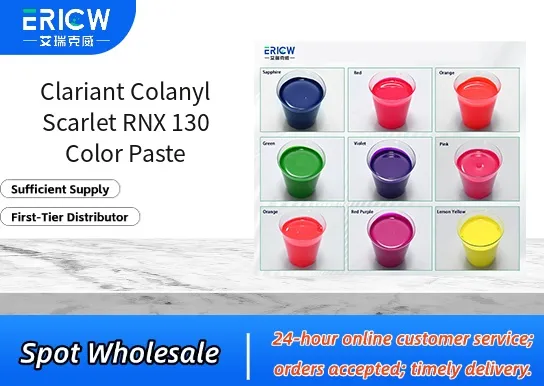
High chroma scarlet shade with excellent lightfastness and weather resistance.
Optimized for low migration and high thermal stability in demanding polymer processing.
Excellent dispersibility in polyolefins, ABS, PS, and engineering thermoplastics.
Compliant with global regulatory standards including FDA 21 CFR and EU Plastics Regulation (EU) No 10/2011.
Low volatile organic compound (VOC) content, supporting sustainable manufacturing practices.
Coloration of injection-molded consumer goods (e.g., appliances, toys, and housings).
Pigmenting extruded profiles and thin-walled packaging containers.
Masterbatch formulation for automotive interior components.
Coloration of medical device housings requiring biocompatibility and color consistency.
High-performance applications in outdoor signage and architectural cladding materials.
| Chemical Type | Organic pigment dispersion (quinacridone-based) |
| Product Form | Paste (polymer carrier-based) |
| Appearance | Viscous, homogeneous red paste |
| Primary Applications | Polyolefins, ABS, PS, PC/ABS blends |
| Key Features | High heat stability (>260 °C), low extractables, excellent batch-to-batch reproducibility |
| Benefits | Reduced filter clogging, improved color yield, consistent hue across processing conditions |
| Regulatory Compliance | FDA 21 CFR §178.3297, EU Directive 2002/72/EC (as amended) |
| Storage Conditions | Store at 15–25 °C; protect from freezing and direct sunlight |
Q1: What types of polymers is Colanyl Scarlet RNX 130 compatible with?
A: Colanyl Scarlet RNX 130 is specifically formulated for use in polyolefins (e.g., PP and HDPE), as well as certain engineering thermoplastics such as ABS and PS. Compatibility should always be verified under actual processing conditions due to variations in resin grade and additive package.
Q2: Is this color paste suitable for food-contact applications?
A: Colanyl Scarlet RNX 130 is designed for non-food-contact applications. For food-contact use, Clariant offers alternative color pastes that comply with relevant regional regulatory frameworks — please consult your Clariant representative for appropriate food-grade solutions.
Q3: How should the paste be incorporated into the polymer melt?
A: The paste is typically introduced via gravimetric or volumetric dosing directly into the extruder throat or injection molding hopper. Pre-blending with carrier resin may be used for improved dispersion, especially at lower dosage levels.
Q4: Does Colanyl Scarlet RNX 130 contain heavy metals or restricted substances?
A: This product is formulated without intentionally added lead, cadmium, mercury, or hexavalent chromium, in alignment with Clariant’s commitment to responsible chemistry. It is not classified as hazardous under GHS for transport or handling under standard conditions.
Contact With Us:
E-mail: wangxingqiang@ericwchem.com
Have a Questions? Call Us:
Add:
Building A1, Jiete Industrial Park, Huangpu District, Guangzhou City, Guangdong Province, China