English
 Español
 tiếng việt
 русский
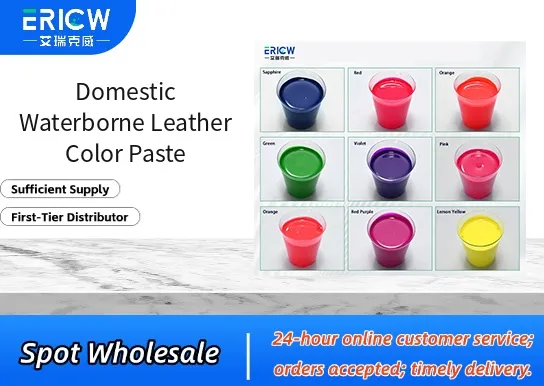
Zero added formaldehyde and APEO-free formulation for enhanced environmental compliance.
Excellent color strength and chromatic consistency across diverse leather substrates.
Superior compatibility with waterborne topcoats and finishing systems without delamination or bleeding.
Fast-drying performance under standard ambient curing conditions (25°C, 60% RH).
Good rub fastness and lightfastness (ISO 105-B02, Grade ≥4 after 20 hrs UV exposure).
Coloration of automotive interior leather (seats, door panels, steering wheels).
Tinting of furniture leather for residential and contract upholstery.
Base coloring for footwear uppers requiring flexible, non-cracking pigmentation.
Shade adjustment in waterborne aniline and semi-aniline leather finishing lines.
Custom hue development for premium handbags, gloves, and leather accessories.
| Chemical Type | Waterborne acrylic-polyurethane hybrid dispersion |
| Product Form | Concentrated liquid paste, ready-to-dilute |
| Appearance | Homogeneous, viscous suspension; free from grit or sediment |
| pH Value (1% aqueous dilution) | 7.8 – 8.5 |
| Solids Content (wt%) | 38 – 42% |
| Viscosity (Brookfield LVT, #3 spindle, 20 rpm, 25°C) | 8,000 – 12,000 cP |
| Storage Stability (unopened, 5–30°C) | ≥12 months |
| VOC Content | <50 g/L (EPA Method 24 compliant) |
Q1: What are the key advantages of using a waterborne leather color paste versus solvent-based alternatives?
A: Domestic Waterborne Leather Color Paste offers improved workplace safety, reduced VOC emissions, and easier handling in standard aqueous coating systems. It eliminates the need for flammable solvent storage and simplifies wastewater treatment compliance in typical tannery or finishing operations.
Q2: Is this product compatible with common leather topcoats and binders?
A: Yes — it is formulated to integrate well with acrylic, polyurethane, and styrene-acrylic dispersions commonly used in domestic leather finishing. Compatibility testing under actual process conditions is recommended due to formulation variability across binder systems.
Q3: How should the color paste be dispersed into a leather coating formulation?
A: Add gradually under moderate agitation during the aqueous phase mixing stage. Avoid high-shear dispersion unless validated, as excessive shear may destabilize the pigment dispersion. Pre-dilution with a portion of the base medium can aid uniform incorporation.
Q4: Does this color paste require special storage conditions?
A: Store in tightly sealed containers at temperatures between 5 °C and 35 °C, away from direct sunlight and freezing conditions. Prolonged exposure to high humidity or temperature extremes may affect viscosity stability and dispersion integrity over time.
Contact With Us:
E-mail: wangxingqiang@ericwchem.com
Have a Questions? Call Us:
Add:
Building A1, Jiete Industrial Park, Huangpu District, Guangzhou City, Guangdong Province, China