English
 Español
 tiếng việt
 русский
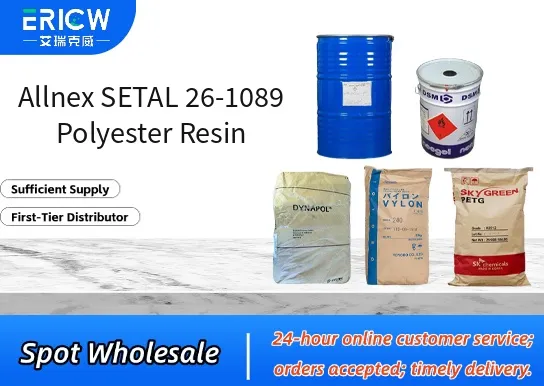
Highly reactive alkyd-modified polyester resin designed for fast-cure coil and can coatings.
Excellent gloss retention and color stability under UV exposure and thermal aging.
Good flexibility and impact resistance, enabling compatibility with pre-painted and post-forming processes.
Optimized for high-solids formulations, supporting VOC reduction without compromising film performance.
Consistent batch-to-batch reproducibility, ensuring reliable manufacturing scale-up.
Coil coating topcoats for architectural and appliance substrates.
Can and closure coatings requiring excellent mar resistance and sterilization stability.
General-purpose industrial maintenance coatings on metal substrates.
Two-coat-one-bake (2C1B) systems for automotive trim and non-structural components.
UV-curable hybrid systems where thermal cure support is required.
| Chemical Type | Alkyd-modified saturated polyester |
| Product Form | Liquid, solvent-based |
| Appearance | Clear to pale yellow viscous liquid |
| Primary Applications | Coil coatings, can coatings, industrial metal finishes |
| Key Features | Fast cure, high gloss, excellent flexibility |
| Benefits | Reduced energy consumption, enhanced line speed, improved substrate adhesion |
| Solvent System | Aromatic hydrocarbons and esters (typical) |
| Recommended Baking Schedule | 230 °C for 30–60 seconds (coil), or 180–200 °C for 10–20 minutes (can) |
Q1: What is the primary application area for SETAL 26-1089?
A: SETAL 26-1089 is a solvent-based unsaturated polyester resin designed primarily for high-performance coil coating and metal decorating applications, where excellent gloss retention, hardness development, and resistance to yellowing under UV exposure are required.
Q2: Is SETAL 26-1089 compatible with common crosslinkers used in coil coatings?
A: Yes, it is formulated to react efficiently with melamine-formaldehyde resins and other amino crosslinkers typically employed in thermosetting coil coating systems. Compatibility and cure response should be verified in the final formulation under intended curing conditions.
Q3: How does SETAL 26-1089 perform in terms of flexibility and adhesion on cold-formed substrates?
A: It delivers good substrate adhesion and bend resistance on pre-painted metal, including steel and aluminum, supporting typical forming operations such as roll-forming and shallow drawing without cracking or delamination.
Q4: Can SETAL 26-1089 be used in low-VOC formulations?
A: While inherently solvent-based, it can be incorporated into reformulated systems targeting reduced VOC content—typically by partial replacement with reactive diluents or integration into hybrid resin architectures—subject to performance validation across cure profile, film properties, and regulatory compliance.
Q5: What storage conditions are recommended to maintain stability?
A: Store in tightly sealed containers in a cool, dry, well-ventilated area away from direct sunlight and sources of heat or ignition. Prolonged exposure to elevated temperatures or moisture may affect viscosity and reactivity over time.
Contact With Us:
E-mail: wangxingqiang@ericwchem.com
Have a Questions? Call Us:
Add:
Building A1, Jiete Industrial Park, Huangpu District, Guangzhou City, Guangdong Province, China