English
 Español
 tiếng việt
 русский
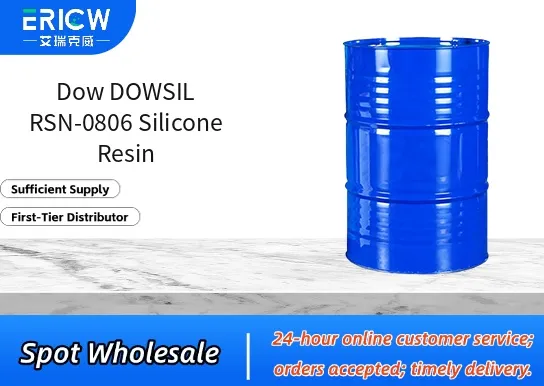
High thermal stability with continuous use up to 200 °C
Excellent electrical insulation properties even under humid conditions
Good compatibility with organic resins and pigments for hybrid formulations
Low surface energy enabling superior release performance and anti-adhesion behavior
Solvent-based liquid form facilitating easy integration into coating and impregnation processes
Heat-resistant coatings for industrial ovens and exhaust systems
Electrical insulation varnishes for motor windings and transformers
Release coatings for high-temperature composite molding tools
Hybrid silicone-organic topcoats for architectural metal substrates
Binders in high-performance ceramic and refractory coatings
| Chemical Type | Methyl-phenyl silicone resin |
| Product Form | Liquid (solvent-based) |
| Appearance | Clear, colorless to pale yellow liquid |
| Solvent System | Aromatic hydrocarbon blend |
| Non-Volatile Content (wt%) | 50–55% |
| Viscosity (25 °C, mPa·s) | 1,500–3,000 |
| Density (25 °C, g/cm³) | 0.92–0.96 |
| Flash Point (PMCC, °C) | 45–55 |
Q1: What is the primary function of DOWSIL RSN-0806 in coating formulations?
A: DOWSIL RSN-0806 is a reactive silicone resin designed to enhance surface properties—particularly slip, mar resistance, and substrate wetting—in high-performance industrial and protective coatings. It functions as a crosslinkable additive that integrates into the binder matrix, contributing to durable, low-surface-energy characteristics without significant migration or bloom.
Q2: Is DOWSIL RSN-0806 compatible with common organic resin systems?
A: Yes—it exhibits good compatibility with a broad range of thermosetting resins including acrylics, polyesters, alkyds, and epoxy-based systems. Its reactive silanol groups enable covalent integration during cure, supporting stable dispersion and minimizing phase separation when properly formulated and processed.
Q3: How should DOWSIL RSN-0806 be incorporated into a coating formulation?
A: It is typically added during the let-down or post-additive stage under moderate agitation. Pre-dilution in a compatible solvent or carrier resin may improve dispersion uniformity. Avoid high-shear mixing at elevated temperatures prior to full formulation stabilization, as premature condensation could affect performance consistency.
Q4: Does DOWSIL RSN-0806 require heat curing to achieve optimal performance?
A: While it can undergo condensation reactions at ambient temperature over time, full crosslinking and maximum property development generally occur during thermal cure—typically within standard baking schedules used for industrial coil or appliance coatings (e.g., 120–200 °C for several minutes). Performance benefits scale with degree of cure completion.
Contact With Us:
E-mail: wangxingqiang@ericwchem.com
Have a Questions? Call Us:
Add:
Building A1, Jiete Industrial Park, Huangpu District, Guangzhou City, Guangdong Province, China