English
 Español
 tiếng việt
 русский
Excellent abrasion resistance for demanding mechanical service life requirements.
High elasticity and outstanding rebound resilience across a wide temperature range.
Good processability via injection molding and extrusion with low melt viscosity.
Hydrolysis-resistant formulation suitable for humid or wet-environment applications.
Low compression set ensuring long-term shape retention under dynamic loading.
Automotive interior trim components including instrument panel skins and door inserts.
Industrial rollers and conveyor belts requiring high wear resistance and flexibility.
Footwear midsoles and outsoles for performance sports and work footwear.
Flexible hoses and fluid transfer tubing in hydraulic and pneumatic systems.
Consumer electronics protective casings and soft-touch overmolded grips.
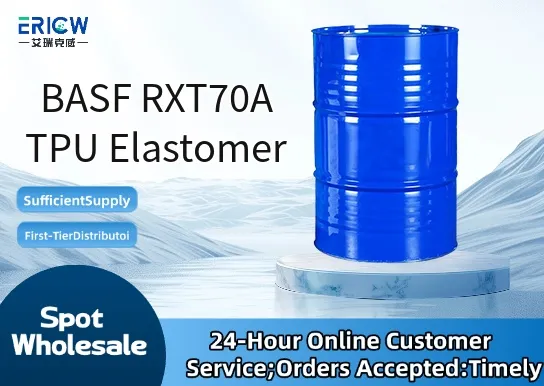
| Chemical Type | Thermoplastic Polyurethane (TPU), polyester-based |
| Product Form | Pellets |
| Appearance | Off-white to light beige, free-flowing granules |
| Shore A Hardness (ASTM D2240) | 70 ± 2 |
| Melt Flow Index (230 °C / 2.16 kg, ASTM D1238) | 10–14 g/10 min |
| Density (ASTM D792) | 1.18–1.20 g/cm³ |
| Key Features | High elasticity, hydrolysis resistance, excellent process stability |
| Primary Applications | Soft-touch overmolding, flexible industrial parts, durable consumer goods |
Q1: What is the primary application domain for RXT70A?
A: RXT70A is a thermoplastic polyurethane elastomer specifically engineered for high-performance extrusion and injection molding applications, with strong suitability in automotive interior components, industrial hoses, and flexible technical profiles requiring excellent abrasion resistance and low-temperature flexibility.
Q2: How does RXT70A differ from standard TPU grades in terms of processing behavior?
A: RXT70A features optimized melt flow characteristics and reduced viscosity sensitivity to shear rate, enabling stable extrusion at higher line speeds and improved mold filling in complex geometries—without compromising mechanical recovery or surface finish.
Q3: Is RXT70A compatible with common engineering thermoplastics for co-extrusion or overmolding?
A: Yes, RXT70A demonstrates good interfacial adhesion with polypropylene (PP), polyethylene (PE), and certain polyamides (PA) when processed under controlled temperature and residence time conditions—making it suitable for multi-material systems such as soft-touch grips and sealing profiles.
Q4: What are the key storage and handling recommendations to maintain RXT70A performance?
A: RXT70A is hygroscopic and must be dried prior to processing—typically at 80–90 °C for 2–4 hours using desiccant-assisted drying. It should be stored in original sealed packaging under dry, cool conditions (<25 °C, <40% RH) to prevent moisture uptake and avoid prolonged exposure to ambient humidity before use.
Contact With Us:
E-mail: wangxingqiang@ericwchem.com
Have a Questions? Call Us:
Add:
Building A1, Jiete Industrial Park, Huangpu District, Guangzhou City, Guangdong Province, China