English
 Español
 tiếng việt
 русский
High thermal stability up to 800 °C, suitable for high-temperature processing environments.
Excellent lightfastness and weather resistance, maintaining color integrity under prolonged UV exposure.
Non-toxic and heavy-metal-free formulation compliant with global regulatory standards including EN 71-3 and RoHS.
Superior dispersion performance in aqueous and solvent-based systems without requiring additional dispersants.
Consistent particle size distribution ensuring uniform color strength and minimal batch-to-batch variation.
Ceramic glazes and frits for tableware and architectural tiles.
High-performance coatings for industrial equipment and automotive refinishes.
Coloration of refractory materials including fire bricks and kiln furniture.
Pigmentation of construction materials such as concrete pavers and precast architectural elements.
Plastic color concentrates for engineering thermoplastics used in outdoor applications.
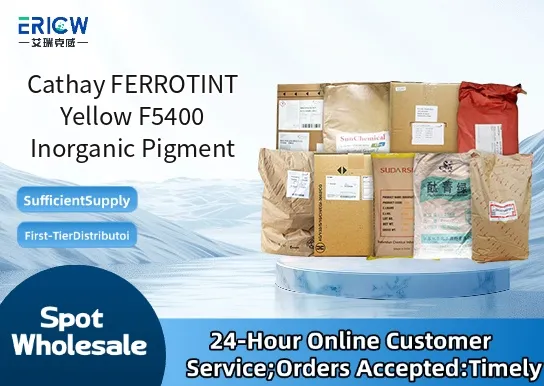
| Chemical Type | Complex iron oxide-based inorganic pigment (mixed metal oxide) |
| Product Form | Fine, free-flowing powder |
| Appearance | Yellow-orange granular powder |
| Primary Applications | Ceramics, refractories, architectural coatings, construction materials |
| Key Features | Thermal stability, UV resistance, chemical inertness, low oil absorption |
| Benefits | Color consistency, regulatory compliance, processing versatility, long-term durability |
| Storage Conditions | Store in a cool, dry place; protect from moisture and direct sunlight |
| Shelf Life | 36 months from date of manufacture under recommended storage conditions |
Q1: What is the primary chemical composition of Cathay FERROTINT Yellow F5400?
A: Cathay FERROTINT Yellow F5400 is an inorganic yellow pigment based on modified iron oxide-hydroxide (goethite-type) chemistry, engineered for enhanced thermal stability and consistent chroma in demanding processing environments.
Q2: Is this pigment suitable for high-temperature polymer processing, such as polypropylene or engineering thermoplastics?
A: Yes — F5400 is specifically formulated to withstand processing temperatures up to 280 °C, making it compatible with common thermoplastics including PP, PE, and certain engineering resins where organic yellows would degrade.
Q3: How does F5400 compare to traditional cadmium-based yellow pigments in terms of regulatory compliance and safety?
A: As a heavy-metal-free iron oxide derivative, F5400 avoids restrictions associated with cadmium, lead, and chromium(VI), supporting compliance with global regulatory frameworks for consumer goods, toys, and packaging—without compromising lightfastness or weather resistance.
Q4: Can F5400 be used in water-based coatings and inks without dispersion additives?
A: While F5400 exhibits good compatibility with aqueous systems, optimal performance requires standard pigment dispersants and milling to achieve full deagglomeration and stable rheology — it is not pre-dispersed or surface-treated for direct water-phase use.
Q5: What is the typical dosage range when using F5400 in plastic masterbatches?
A: Dosage depends on the required shade intensity and base polymer, but F5400 is generally used at low concentrations — typically ranging from 0.1% to 2% by weight — due to its high tinting strength and efficient opacity development.
Contact With Us:
E-mail: wangxingqiang@ericwchem.com
Have a Questions? Call Us:
Add:
Building A1, Jiete Industrial Park, Huangpu District, Guangzhou City, Guangdong Province, China