English
 Español
 tiếng việt
 русский
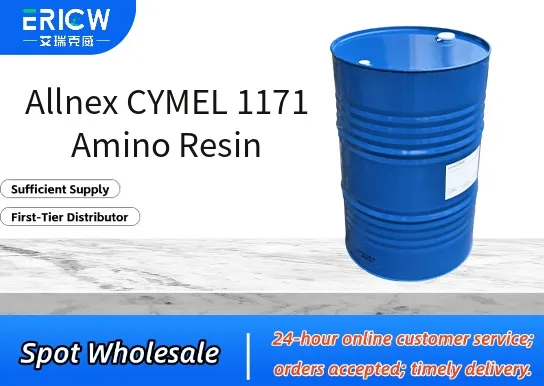
Highly reactive melamine-formaldehyde resin offering rapid cure at low to moderate baking temperatures.
Excellent compatibility with polyester, acrylic, and alkyd resins in solventborne and high-solids coating systems.
Delivers outstanding hardness, chemical resistance, and gloss retention in thermoset coatings.
Low free formaldehyde content, supporting improved workplace safety and regulatory compliance.
Good hydrolytic stability during storage, enabling extended shelf life under recommended conditions.
Automotive OEM and refinish topcoats requiring high durability and appearance.
Industrial coil coatings for metal substrates such as steel and aluminum.
Appliance finishes demanding superior scratch and detergent resistance.
General-purpose metal packaging coatings (e.g., food and beverage cans).
High-performance powder coating formulations for architectural and functional applications.
| Chemical Type | Melamine-formaldehyde crosslinker |
| Product Form | Clear to pale yellow liquid |
| Appearance | Homogeneous, mobile liquid |
| Non-Volatile Content (wt%, ASTM D1259) | 80–84% |
| Viscosity (25°C, mPa·s, ASTM D4292) | 150–300 |
| Free Formaldehyde (wt%, ASTM D5577) | ≤ 0.3% |
| Acid Number (mg KOH/g, ASTM D1639) | 2–6 |
| Primary Applications | Crosslinker for high-performance thermoset coatings on metal |
Q1: What is the primary function of CYMEL 1171 in coating formulations?
A: CYMEL 1171 functions as a highly reactive melamine-formaldehyde crosslinker, designed to enhance hardness, chemical resistance, and thermal stability in thermosetting coatings—particularly in high-performance industrial and coil coating systems.
Q2: Is CYMEL 1171 compatible with hydroxyl-functional acrylics and polyesters?
A: Yes, CYMEL 1171 exhibits excellent compatibility and reactivity with hydroxyl-terminated resins, including acrylics, polyesters, and alkyds, enabling efficient curing at moderate bake temperatures typically between 120–160 °C.
Q3: How should CYMEL 1171 be stored to maintain optimal performance?
A: Store in tightly sealed original containers in a cool, dry, well-ventilated area below 30 °C. Prolonged exposure to elevated temperatures or humidity may lead to premature condensation or viscosity increase, affecting shelf life and cure response.
Q4: Does CYMEL 1171 require a catalyst for efficient curing?
A: While it can cure uncatalyzed at higher temperatures, optimal cure speed and film properties are typically achieved with acid catalysts such as p-toluenesulfonic acid (p-TSA) or blocked acid alternatives—dosage depends on formulation requirements and desired cure profile.
Q5: Can CYMEL 1171 be used in low-VOC or high-solids coating systems?
A: Yes, CYMEL 1171 is formulated to support low-VOC and high-solids applications due to its high functionality and relatively low volatile content, making it suitable for modern regulatory-compliant industrial coating technologies.
Contact With Us:
E-mail: wangxingqiang@ericwchem.com
Have a Questions? Call Us:
Add:
Building A1, Jiete Industrial Park, Huangpu District, Guangzhou City, Guangdong Province, China