English
 Español
 tiếng việt
 русский
Excellent melt processability for high-speed extrusion and injection molding
Outstanding low-temperature flexibility and impact resistance down to –40 °C
Superior compatibility with polypropylene (PP) and polyethylene (PE) for robust thermoplastic elastomer (TPE) blends
Low compression set for durable sealing and gasketing performance
Good UV and weather resistance without requiring additional stabilizers
Automotive interior trim components including door panels and instrument bezels
Soft-touch overmolding for power tools and consumer electronics housings
Flexible seals and gaskets for HVAC and appliance applications
TPE blends for medical device grips and non-lubricated tubing interfaces
Weather-resistant cable jacketing and wire insulation for outdoor infrastructure
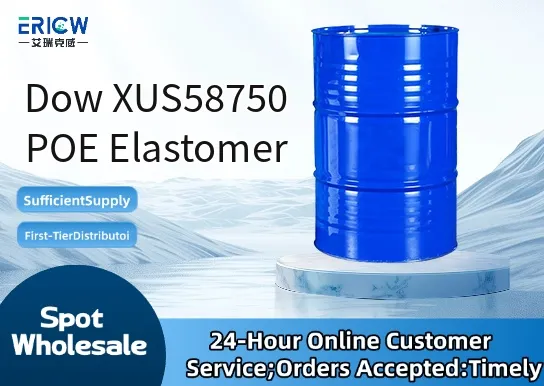
| Chemical Type | Polyolefin Elastomer (POE), ethylene-octene copolymer |
| Product Form | Pellets |
| Appearance | Off-white to light tan, free-flowing cylindrical pellets |
| Primary Applications | Thermoplastic elastomer (TPE) formulations, PP/PE modification, soft-touch overmolding |
| Key Features | High elasticity, excellent clarity in blends, low extractables |
| Benefits | Enhanced toughness, improved processing efficiency, reduced part weight vs. TPU |
| Processing Method | Injection molding, extrusion, blow molding |
| Regulatory Compliance | Meets FDA 21 CFR 177.1520 for indirect food contact (when compounded per Dow guidelines) |
Q1: What is the primary function of Dow XUS58750 in polymer blends?
A: Dow XUS58750 is a polyolefin elastomer (POE) designed primarily as a toughening agent and impact modifier—especially for polypropylene (PP) and other semi-crystalline thermoplastics—improving low-temperature ductility, melt elasticity, and overall toughness without significantly compromising stiffness or processability.
Q2: Is Dow XUS58750 suitable for use in food-contact applications?
A: Dow XUS58750 is not pre-approved for direct food-contact use under major global regulatory frameworks. Its suitability for such applications depends on final formulation, processing conditions, and compliance verification by the end-user with applicable local regulations—including FDA 21 CFR, EU Framework Regulation (EC) No 1935/2004, and relevant migration assessments.
Q3: How does Dow XUS58750 compare to traditional EPDM or EPR impact modifiers?
A: Unlike EPDM or EPR, Dow XUS58750 offers superior compatibility with polyolefins due to its ethylene-octene copolymer structure and narrow molecular weight distribution—leading to more consistent dispersion, enhanced interfacial adhesion, and improved balance of impact strength and flow behavior during processing.
Q4: What processing methods are recommended for Dow XUS58750?
A: Dow XUS58750 is compatible with standard thermoplastic processing techniques including injection molding, extrusion, and blow molding. It exhibits good thermal stability and low melt viscosity, supporting efficient mixing in both twin-screw compounding and direct injection processes.
Q5: Can Dow XUS58750 be used in combination with fillers or reinforcing agents?
A: Yes—Dow XUS58750 is commonly used alongside mineral fillers (e.g., talc, calcium carbonate) and glass fibers in PP-based systems. It helps mitigate filler-induced embrittlement and supports improved stress transfer, particularly in automotive interior and structural components.
Contact With Us:
E-mail: wangxingqiang@ericwchem.com
Have a Questions? Call Us:
Add:
Building A1, Jiete Industrial Park, Huangpu District, Guangzhou City, Guangdong Province, China