English
 Español
 tiếng việt
 русский
High reactivity with epoxy resins, enabling rapid crosslinking at elevated temperatures.
Excellent thermal stability and chemical resistance in cured thermoset systems.
Low volatility and minimal odor, supporting safer handling in industrial environments.
Consistent batch-to-batch performance due to strict GMP-aligned manufacturing control.
Compatible with standard epoxy resin formulations without requiring catalysts or co-curing agents.
Powder coating for metal substrates including appliances, automotive parts, and architectural aluminum.
Electrical insulation coatings for transformers, busbars, and motor windings.
High-performance composite matrices in aerospace and wind turbine blade applications.
Anti-corrosive protective linings for storage tanks and piping systems.
Adhesives and encapsulants requiring thermal endurance and dimensional stability.
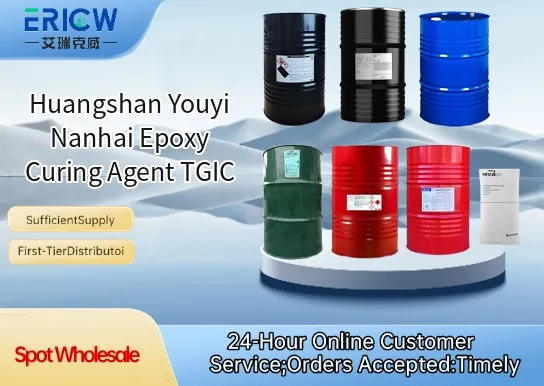
| Chemical Type | Triglycidyl Isocyanurate (TGIC) |
| Product Form | White crystalline powder |
| Appearance | Free-flowing, homogeneous granular solid |
| Primary Applications | Epoxy powder coatings, electrical insulation, high-temp composites |
| Key Features | Thermal curing agent, low migration, high crosslink density |
| Benefits | Enhanced gloss retention, improved UV resistance, excellent adhesion |
| Storage Conditions | Store in cool, dry, well-ventilated area below 30°C; avoid moisture exposure |
| Shelf Life | 24 months from date of manufacture under recommended conditions |
Q1: What is the primary function of TGIC in epoxy systems?
A: TGIC (Triglycidyl Isocyanurate) serves as a highly efficient heterocyclic curing agent for epoxy resins, enabling rapid crosslinking at elevated temperatures to yield thermoset coatings with excellent chemical resistance, hardness, and thermal stability.
Q2: Is this TGIC-based curing agent suitable for powder coating applications?
A: Yes — Huangshan Youyi Nanhai TGIC is specifically formulated for high-performance epoxy-polyester hybrid and pure epoxy powder coatings, offering good storage stability, smooth film formation, and consistent reactivity during standard curing cycles (typically 180–200 °C for 10–20 minutes).
Q3: How does TGIC compare to aliphatic amine or anhydride curing agents?
A: Unlike amines or anhydrides, TGIC provides superior UV stability and hydrolytic resistance in cured films, with no volatile by-products during cure. It is particularly valued where long-term outdoor durability and resistance to acidic or alkaline environments are required.
Q4: What safety and handling precautions should be observed?
A: As a reactive solid, TGIC requires standard industrial hygiene practices: avoid inhalation of dust, prevent skin and eye contact, and use appropriate PPE (gloves, goggles, respirator if airborne dust is present). Store in a cool, dry, well-ventilated area away from strong oxidizers.
Contact With Us:
E-mail: wangxingqiang@ericwchem.com
Have a Questions? Call Us:
Add:
Building A1, Jiete Industrial Park, Huangpu District, Guangzhou City, Guangdong Province, China