English
 Español
 tiếng việt
 русский
High thermal stability up to 250 °C for extended service life in demanding environments.
Excellent electrical insulation properties, maintaining performance across wide temperature and humidity ranges.
Good compatibility with organic resins and pigments, enabling flexible formulation in hybrid systems.
Low volatile organic compound (VOC) content, supporting sustainable manufacturing and regulatory compliance.
Forms durable, hydrophobic films with outstanding UV resistance and weathering stability.
Heat-resistant coatings for industrial exhaust systems and oven linings.
Electrical insulating varnishes for motors, transformers, and magnet wires.
Binders in high-performance ceramic and refractory coatings.
Matrix resin in silicone-modified organic enamel systems for architectural metal finishes.
Surface treatment agents for improving water repellency and dust resistance of mineral substrates.
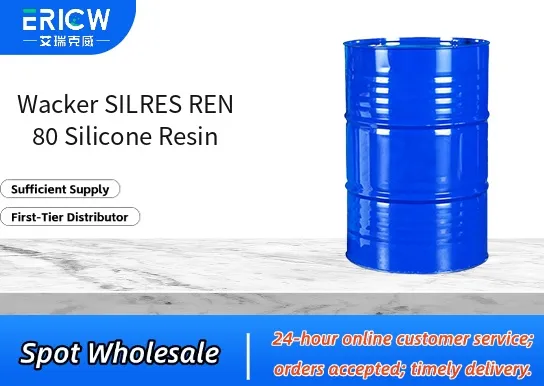
| Chemical Type | Methyl-phenyl silicone resin |
| Product Form | Clear to slightly hazy liquid |
| Appearance | Colorless to pale yellow, homogeneous liquid |
| Solvent System | Aromatic hydrocarbons (e.g., xylene) |
| Solids Content | Approx. 80 wt.% |
| Viscosity (25 °C, DIN 53019) | 400–700 mPa·s |
| Density (20 °C) | 0.98–1.02 g/cm³ |
| Flash Point (DIN 51758) | Approx. 45 °C |
Q1: What is the primary function of SILRES REN 80 in coating formulations?
A: SILRES REN 80 functions primarily as a crosslinking agent and surface modifier in solvent-based and high-solids organic coatings. It enhances weather resistance, improves scratch and mar resistance, and contributes to long-term hydrophobicity and substrate adhesion without significantly affecting film flexibility.
Q2: Is SILRES REN 80 compatible with common resin systems such as acrylics, alkyds, and polyurethanes?
A: Yes, SILRES REN 80 demonstrates broad compatibility with thermosetting organic resins including acrylics, alkyds, polyester, and polyurethane systems. Its reactivity profile allows for co-crosslinking via condensation reactions under typical baking conditions, though compatibility testing in the final formulation is recommended to optimize performance and avoid phase separation.
Q3: How should SILRES REN 80 be incorporated into a coating formulation?
A: SILRES REN 80 is typically added during the let-down stage using standard high-shear mixing equipment. It is supplied as a low-viscosity liquid and can be diluted with common organic solvents (e.g., xylene, butyl acetate) if needed. Pre-dilution helps ensure uniform dispersion and minimizes localized gelation risk. Avoid prolonged exposure to moisture prior to incorporation.
Q4: Does SILRES REN 80 require a catalyst to achieve full cure?
A: While SILRES REN 80 undergoes thermal condensation at elevated temperatures (typically above 120 °C), the addition of a tin-based catalyst (e.g., dibutyltin dilaurate) or titanium chelates may accelerate crosslinking and improve through-cure—especially in thick films or lower-bake applications. Catalyst selection and dosage depend on the overall formulation chemistry and processing conditions.
Contact With Us:
E-mail: wangxingqiang@ericwchem.com
Have a Questions? Call Us:
Add:
Building A1, Jiete Industrial Park, Huangpu District, Guangzhou City, Guangdong Province, China