English
 Español
 tiếng việt
 русский
High reactivity with melamine-formaldehyde and urea-formaldehyde resins for rapid cure kinetics.
Excellent compatibility with alkyd, polyester, and acrylic binder systems in thermosetting coatings.
Enhanced crosslink density delivering superior hardness, chemical resistance, and gloss retention.
Low free formaldehyde content, supporting compliance with stringent VOC and emissions regulations.
Consistent batch-to-batch performance ensured by INEOS’s controlled manufacturing process.
Automotive OEM and refinish topcoats requiring high durability and appearance.
Industrial maintenance coatings for metal substrates in harsh environments.
Appliance coatings (e.g., refrigerators, washing machines) demanding scratch and stain resistance.
Coil coating systems where rapid line speed and excellent film formation are critical.
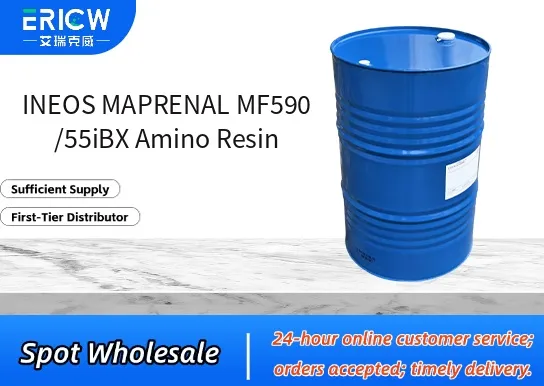
| Chemical Type | Melamine-formaldehyde crosslinker with isobutanol modification |
| Product Form | Clear to pale yellow liquid |
| Appearance | Homogeneous, low-viscosity solution |
| Primary Applications | Crosslinking agent for thermosetting solventborne coatings |
| Key Features | High functionality, low volatility, good storage stability |
| Benefits | Improved pot life control, reduced baking temperature, enhanced film integrity |
| Storage Conditions | Store in tightly closed containers at 10–30°C; protect from freezing |
Q1: What is the primary function of INEOS MAPRENAL MF590/55iBX in coating formulations?
A: It serves as a highly reactive crosslinking agent for hydroxyl-functional resins—such as acrylics, polyesters, and alkyds—enabling robust thermoset network formation during curing. Its balanced reactivity profile supports good pot life while delivering excellent hardness, chemical resistance, and gloss retention in baked finishes.
Q2: How does the "iBX" designation impact formulation handling and performance?
A: The "iBX" suffix indicates partial blocking with isobutyl alcohol, which moderates initial reactivity and enhances compatibility with common solvent-borne and high-solids systems. This improves storage stability and reduces premature gelation risk, particularly in ambient-mix formulations prior to thermal cure.
Q3: Is MF590/55iBX suitable for low-VOC or high-solids applications?
A: Yes—it is formulated for compatibility with modern low-VOC and high-solids coating systems. Its relatively low free formaldehyde content and favorable viscosity profile support efficient incorporation without excessive solvent demand, helping formulators meet evolving environmental and regulatory expectations.
Q4: What are typical cure conditions when using this amino resin?
A: Optimal cure typically occurs in conventional convection ovens at temperatures between 120 °C and 160 °C, with dwell times ranging from 10 to 30 minutes depending on film thickness, substrate, and overall formulation balance. Catalysis with weak organic acids may be used to adjust cure window and final properties.
Contact With Us:
E-mail: wangxingqiang@ericwchem.com
Have a Questions? Call Us:
Add:
Building A1, Jiete Industrial Park, Huangpu District, Guangzhou City, Guangdong Province, China