English
 Español
 tiếng việt
 русский
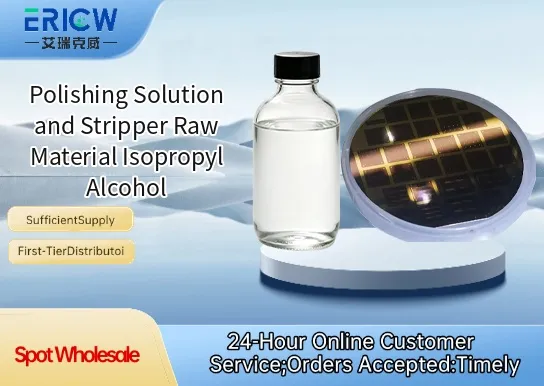
High-purity grade (≥99.9% assay) ensures consistent performance in precision polishing and stripping formulations.
Low water content (<0.05%) minimizes hydrolysis risk in moisture-sensitive chemical systems.
Fast evaporation rate enables rapid residue removal and short process cycle times.
Non-corrosive to aluminum, stainless steel, and common PCB substrates under standard handling conditions.
Readily miscible with esters, ketones, and glycol ethers for flexible formulation integration.
Primary solvent carrier in semiconductor wafer post-CMP (Chemical Mechanical Planarization) cleaning solutions.
Key component in photoresist and etch-residue strippers for flat panel display (FPD) manufacturing.
Carrier and rinse medium in optical lens and precision optics polishing concentrates.
Co-solvent in high-performance metal surface degreasers for aerospace and medical device components.
Stabilizing diluent in formulated PCB solder mask strippers and conformal coating removers.
| Chemical Type | Secondary alcohol, organic solvent |
| Product Form | Clear, colorless liquid |
| Appearance | Transparent, free of suspended matter or haze |
| Melting Point | −89 °C |
| Boiling Point | 82.6 °C at 760 mmHg |
| Primary Applications | Polishing solution base, stripper co-solvent, precision rinse agent |
| Key Features | Low toxicity profile, low surface tension (21.7 mN/m at 20 °C), high volatility |
| Regulatory Compliance | REACH registered; compliant with US EPA TSCA Inventory; non-RCRA hazardous waste when pure |
| Common Compatible Systems | Suitability |
| Acetone–IPA binary blends | Highly Recommended – Excellent miscibility and synergistic residue solubilization |
| Glycol ether-based strippers (e.g., PGMEA, DPGME) | Recommended – Requires controlled blending ratio to maintain volatility balance |
| Alkaline aqueous stripper concentrates (pH >12) | Suitable – Stable as pre-dilution co-solvent; avoid prolonged contact with hot concentrated alkali |
| Fluorinated surfactant systems | Recommended – Enhances wetting without foam generation or phase separation |
Q1: What is the CAS number for this isopropyl alcohol grade?
A: The CAS Registry Number is 67-63-0. This applies to all commercially pure isopropyl alcohol, including our polishing and stripping grade.
Q2: What is the recommended usage concentration in a polishing solution formulation?
A: Typical use levels range from 30–70 wt% depending on viscosity requirements, evaporation control, and compatibility with active ingredients (e.g., chelants, surfactants). Pilot-scale compatibility testing is advised before full-scale implementation.
Q3: How does this IPA grade differ from technical-grade isopropyl alcohol in stripping applications?
A: Our grade features tighter impurity controls—especially lower aldehydes (<10 ppm), peroxides (<1 ppm), and heavy metals (<0.1 ppm)—critical for preventing micro-defects and substrate oxidation during high-precision stripping.
Q4: Does this material meet USP or EP specifications for pharmaceutical use?
A: No—this grade is manufactured and tested for industrial polishing and stripping applications only. It is not certified to USP, EP, or JP monographs and is not intended for direct pharmaceutical or food-contact use.
Q5: Is extractable migration a concern when used in final rinse steps for electronic components?
A: When used in validated rinse processes (e.g., two-stage IPA rinse followed by nitrogen purge), residual IPA extraction is negligible (<1 ppm on surface) and well below IEC 61249-2-21 limits for halogen-free electronics assembly.
Contact With Us:
E-mail: wangxingqiang@ericwchem.com
Have a Questions? Call Us:
Add:
Building A1, Jiete Industrial Park, Huangpu District, Guangzhou City, Guangdong Province, China