English
 Español
 tiếng việt
 русский
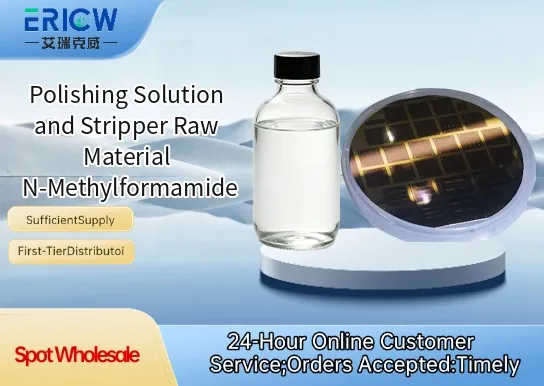
Highly effective polar aprotic solvent with exceptional solvating power for resins, polymers, and photoresist materials.
Low volatility and high boiling point (199–201 °C) enabling stable performance in elevated-temperature stripping and polishing processes.
Excellent thermal and chemical stability under controlled industrial conditions, minimizing decomposition during recirculation.
Compatible with stainless steel and high-density polyethylene (HDPE) process equipment, supporting long-term system integrity.
Readily miscible with water, alcohols, ketones, and chlorinated hydrocarbons—facilitating formulation flexibility and residue removal.
Core raw material in semiconductor wafer cleaning formulations for post-CMP (Chemical Mechanical Polishing) residue removal.
Active component in precision metal surface strippers for aerospace-grade anodized aluminum and titanium alloys.
Solvent carrier in optical lens polishing slurries to disperse cerium oxide abrasives and prevent agglomeration.
Key ingredient in printed circuit board (PCB) solder mask and legend ink strippers for selective layer removal.
Enabling solvent in specialty coating reformulation for automotive trim reconditioning and electroplated finish restoration.
| Chemical Type | Polar aprotic amide solvent |
| Product Form | Liquid, clear and colorless |
| Appearance | Clear, slightly viscous liquid; no suspended particles or phase separation |
| Melting Point | −4 °C |
| Boiling Point | 199–201 °C at 760 mmHg |
| Primary Applications | Polishing solution base, photoresist stripper co-solvent, polymer dissolution aid |
| Key Features | High dipole moment (3.9 D), low vapor pressure (0.05 mmHg at 20 °C), excellent HLB balance |
| Regulatory Compliance | REACH registered; compliant with EU Directive 2004/42/EC (VOC limits for coatings); SDS available per GHS Rev.10 |
| Common Compatible Systems | Suitability |
| Stainless Steel 316 Process Tanks & Piping | Highly Recommended – No corrosion observed under pH-neutral, ambient-to-60 °C operating conditions |
| HDPE and PVDF Chemical Delivery Systems | Highly Recommended – Excellent resistance to stress cracking and swelling |
| Ultrasonic Cleaning Baths (25–45 kHz) | Recommended – Stable performance without excessive foaming or cavitation erosion |
| Recirculating Filtration Units with Polypropylene Cartridges | Suitable – Compatible with standard 0.45 µm PP membranes; minimal extractables |
Q1: What is the CAS Registry Number for N-Methylformamide used in polishing and stripping formulations?
A: The CAS number is 123-39-7. This refers specifically to high-purity (≥99.5%) N-methylformamide meeting ASTM D4327 and ISO 8518 specifications for electronic-grade applications.
Q2: What is the typical recommended concentration range when formulating aqueous-based strippers?
A: For most industrial stripping systems, NMF is used at 15–35 wt% in combination with glycol ethers, organic acids, and surfactants—optimized via compatibility testing to avoid phase separation and ensure substrate safety.
Q3: How does N-Methylformamide compare to N-Methyl-2-pyrrolidone (NMP) in stripping performance and regulatory status?
A: NMF offers comparable solvency for acrylics and epoxies but with lower toxicity potential (no REACH SVHC listing), faster biodegradability (OECD 301D), and exemption from certain VOC reporting thresholds where applicable—making it a preferred alternative in evolving regulatory landscapes.
Q4: Are there documented migration or leaching concerns when using NMF in contact with food-grade or medical device polishing equipment?
A: When properly rinsed (e.g., deionized water ≥3× volume), residual NMF levels fall below 1 ppm—well under FDA 21 CFR §178.3750 and USP <661> limits for non-volatile residues on manufacturing surfaces. Extractables testing per USP <1663> confirms negligible leaching into aqueous simulants.
Contact With Us:
E-mail: wangxingqiang@ericwchem.com
Have a Questions? Call Us:
Add:
Building A1, Jiete Industrial Park, Huangpu District, Guangzhou City, Guangdong Province, China