English
 Español
 tiếng việt
 русский
Excellent transparency and gloss retention under UV exposure
Superior weatherability and long-term color stability
Good melt flow characteristics for extrusion and injection molding
High impact resistance combined with dimensional stability
Low moisture absorption for consistent processing performance
Automotive exterior trim and lighting lenses
Architectural glazing and façade panels
Consumer electronics housings and transparent components
Medical device enclosures requiring optical clarity and sterilization compatibility
Signage and display systems requiring high-gloss, durable surfaces
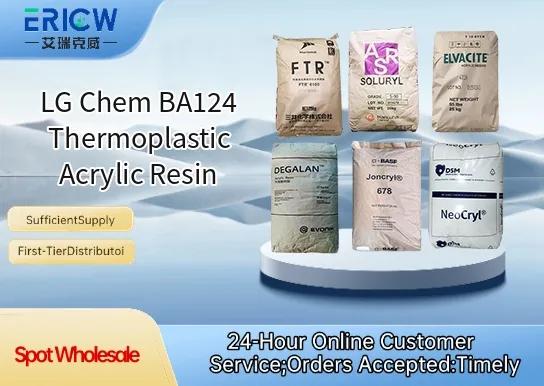
| Chemical Type | Thermoplastic acrylic copolymer |
| Product Form | Pellets |
| Appearance | White to off-white translucent granules |
| Primary Applications | Exterior automotive parts, optical-grade glazing, durable consumer goods |
| Key Features | UV-stabilized, high clarity, thermally stable |
| Benefits | Reduced yellowing, excellent surface hardness, recyclable thermoplastic |
| Melt Flow Rate (230°C/3.8 kg) | 5–7 g/10 min |
| Density (23°C) | 1.18–1.20 g/cm³ |
Q1: What are the primary performance benefits of BA124 in thermoplastic compounding?
A: BA124 enhances melt flow, improves surface gloss and clarity, and contributes to better thermal stability during extrusion or injection molding—particularly beneficial in transparent or high-gloss polypropylene and ABS blends.
Q2: Is BA124 compatible with common engineering thermoplastics beyond standard polyolefins?
A: Yes—BA124 demonstrates good compatibility with ABS, PS, PC/ABS blends, and certain modified polypropylenes. Compatibility should be verified experimentally for each specific formulation due to variations in polymer polarity and processing conditions.
Q3: How does BA124 affect processing temperature windows and shear sensitivity?
A: BA124 typically lowers melt viscosity without significantly reducing thermal degradation onset, allowing for moderate processing temperature reduction and improved screw fill efficiency. It is not highly shear-sensitive, making it suitable for conventional extrusion and injection equipment.
Q4: Can BA124 be used as a compatibilizer in polymer blends?
A: While not designed as a reactive compatibilizer, BA124’s acrylic architecture and controlled molecular weight enable partial interfacial activity in immiscible blends—especially where polarity matching supports improved dispersion and reduced phase separation.
Contact With Us:
E-mail: wangxingqiang@ericwchem.com
Have a Questions? Call Us:
Add:
Building A1, Jiete Industrial Park, Huangpu District, Guangzhou City, Guangdong Province, China