English
 Español
 tiếng việt
 русский
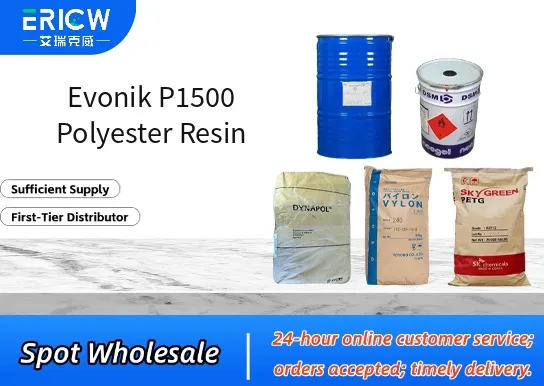
High reactivity with standard styrene monomers for rapid gelation and cycle time reduction.
Excellent mechanical strength and dimensional stability in cured composites.
Low viscosity at ambient temperature, enabling easy handling and improved fiber wet-out.
Good weather resistance and UV stability for outdoor applications.
Consistent batch-to-batch performance supported by Evonik’s stringent quality control.
Fiberglass-reinforced plastic (FRP) tanks and piping systems.
Marine deck and hull components requiring corrosion resistance.
Automotive body panels and under-hood structural parts.
Wind turbine blade shell laminates and structural reinforcements.
Industrial grating, ductwork, and corrosion-resistant linings.
| Chemical Type | Unsaturated polyester resin |
| Product Form | Liquid |
| Appearance | Clear to pale yellow, homogeneous liquid |
| Viscosity (25 °C) | 350–450 mPa·s |
| Acid Value | 18–22 mg KOH/g |
| Reactive Diluent | Styrene (approx. 42 wt%) |
| Density (25 °C) | 1.09–1.11 g/cm³ |
| Storage Stability | ≥6 months at ≤25 °C in sealed containers |
Q1: What is the primary function of Evonik P1500 in polyester resin systems?
A: Evonik P1500 is a reactive polyester resin modifier designed to enhance flexibility, impact resistance, and adhesion in unsaturated polyester (UP) and vinyl ester formulations—particularly in demanding composite applications such as marine laminates and industrial tanks.
Q2: Is P1500 compatible with standard UP resin curing systems?
A: Yes, P1500 is fully compatible with conventional peroxide initiators (e.g., MEKP, BPO) and accelerators used in UP resin processing. It integrates homogeneously without phase separation and does not interfere with standard gel time or cure kinetics when incorporated at recommended levels.
Q3: How does P1500 affect the viscosity and handling properties of formulated resins?
A: P1500 typically reduces system viscosity compared to unmodified high-solids UP resins, improving wet-out of reinforcements and facilitating processing by spray-up, RTM, or infusion. Its low volatility also supports stable rheology during storage and application.
Q4: Can P1500 be used in corrosion-resistant or fire-retardant formulations?
A: Yes—P1500 has demonstrated compatibility with halogen-free flame retardants (e.g., ATH, MDH) and corrosion-inhibiting additives (e.g., phosphates, silanes). Its molecular structure supports formulation stability in high-performance, multi-additive systems targeting chemical resistance or reduced smoke toxicity.
Contact With Us:
E-mail: wangxingqiang@ericwchem.com
Have a Questions? Call Us:
Add:
Building A1, Jiete Industrial Park, Huangpu District, Guangzhou City, Guangdong Province, China