English
 Español
 tiếng việt
 русский
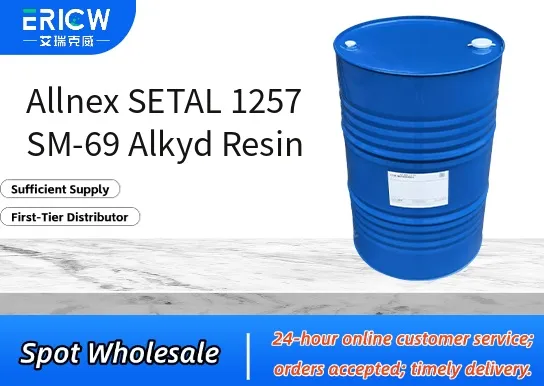
Medium-oil, cobalt-free alkyd resin designed for high-gloss, durable air-drying coatings.
Excellent compatibility with nitrocellulose, PVC plastisols, and other common coating resins.
Offers balanced drying speed and extended pot life in solvent-borne formulations.
Delivers superior gloss retention and flexibility on diverse substrates including metal and wood.
Low-viscosity liquid enables easy handling and efficient formulation without excessive thinning.
General-purpose industrial maintenance coatings for metal structures and equipment.
High-performance wood varnishes and clear finishes for interior architectural applications.
Decorative metallic-effect coatings requiring excellent film integrity and flow.
Undercoats and primers where adhesion, sandability, and overcoat compatibility are critical.
| Chemical Type | Medium-oil alkyd resin (phthalic anhydride–glycerol–fatty acid) |
| Product Form | Liquid |
| Appearance | Clear, pale yellow to amber viscous liquid |
| Primary Applications | Air-drying industrial coatings, wood varnishes, metallic finishes |
| Key Features | Cobalt-free, medium-oil length, good solubility in aromatic and ester solvents |
| Benefits | Reduced VOC potential, enhanced storage stability, improved film clarity and flexibility |
| Solubility | Readily soluble in xylene, toluene, butyl acetate, and ethyl acetate |
Q1: What is the primary application field for SETAL 1257 SM-69?
A: SETAL 1257 SM-69 is a solvent-borne short-oil alkyd resin specifically designed for high-gloss, durable decorative and protective coatings—commonly used in premium wood finishes, metal primers, and maintenance paints where excellent flow, leveling, and film hardness are required.
Q2: Is SETAL 1257 SM-69 compatible with common crosslinkers such as melamine-formaldehyde resins?
A: Yes, this resin is formulated to be readily compatible with amino resins—including melamine-formaldehyde types—and is commonly used in baked systems requiring enhanced thermal stability and chemical resistance. Compatibility and cure profile should be verified under actual formulation conditions.
Q3: How does SETAL 1257 SM-69 perform in terms of drying behavior and film formation?
A: It offers balanced air-drying performance with good through-dry characteristics and develops strong, flexible films with high gloss retention. Its short-oil nature supports rapid solvent release and efficient oxidative crosslinking, especially when combined with cobalt or manganese driers.
Q4: Can SETAL 1257 SM-69 be blended with other resin types, such as acrylics or polyurethanes?
A: Yes, it demonstrates good compatibility with many synthetic resins—including acrylics and hydroxyl-functional polyurethane prepolymers—enabling hybrid systems that balance cost-effectiveness, durability, and application properties. Blending ratios and stability should be assessed empirically in the target solvent system.
Q5: What solvents are typically recommended for diluting SETAL 1257 SM-69?
A: It is fully soluble in common aromatic and aliphatic hydrocarbon solvents, including xylene, Solvent Naphtha (Type II), and high-flash aliphatics. Ketones and esters may also be used depending on the formulation’s volatility and regulatory requirements—always confirm solution stability and viscosity response before scale-up.
Contact With Us:
E-mail: wangxingqiang@ericwchem.com
Have a Questions? Call Us:
Add:
Building A1, Jiete Industrial Park, Huangpu District, Guangzhou City, Guangdong Province, China