English
 Español
 tiếng việt
 русский
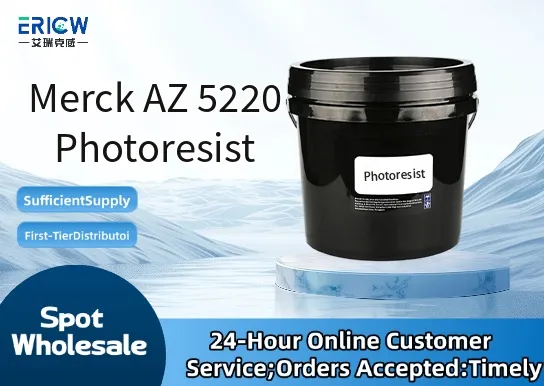
High-resolution positive-tone photoresist optimized for broadband (g/h/i-line) lithography.
Excellent thermal stability and post-exposure bake (PEB) latitude for robust process control.
Superior adhesion to silicon, silicon dioxide, and metal substrates without additional primers.
Low outgassing characteristics suitable for vacuum and high-precision microfabrication environments.
Consistent film-forming properties with low defect density and high uniformity across wafers.
Microelectromechanical systems (MEMS) fabrication requiring deep etch compatibility.
Power semiconductor device patterning, including IGBTs and power MOSFETs.
Research and development of microfluidic devices on silicon and glass substrates.
Photomask repair and prototyping in academic and pilot-line cleanrooms.
Hybrid integration processes involving thick-film lithography (up to 10 µm after soft bake).
| Chemical Type | Novolac resin-based positive photoresist with diazonaphthoquinone (DNQ) photosensitizer |
| Product Form | Liquid solution in propylene glycol monomethyl ether acetate (PGMEA) |
| Appearance | Clear, pale yellow liquid, free of visible particles or gels |
| Viscosity (23 °C) | ~22–24 cP (as supplied, 4.0 wt% solids) |
| Primary Applications | Broadband (g/h/i-line) lithography for features ≥ 1.5 µm |
| Key Features | High sensitivity (~60–90 mJ/cm² at i-line), good resolution, and wide process window |
| Benefits | Reduced cycle time, high throughput, and compatibility with standard wafer processing tools |
| Regulatory Compliance | REACH compliant; RoHS Directive 2011/65/EU applicable; SDS available upon request |
| Common Compatible Systems | Suitability |
| Coat/Develop Track Systems (e.g., Tokyo Electron CLEAN TRACK ACT series) | Highly Recommended – Fully validated for spin-coating, soft bake, develop, and hard bake sequences |
| i-Line Steppers & Scanners (e.g., Canon FPA-3000 i-line, ASML PAS 5500/300) | Highly Recommended – Optimized exposure dose and focus settings documented in Merck technical bulletins |
| Wet Bench Developers (e.g., ND-3, AZ 300 MIF, or 0.26 N TMAH) | Recommended – Standard aqueous tetramethylammonium hydroxide (TMAH) developers yield optimal contrast and sidewall profiles |
| Hard Bake Hotplates (e.g., Suss MicroTec MA8/BA8) | Suitable – Stable performance observed at 110–120 °C for 60–90 seconds |
Q1: What is the CAS Registry Number for Merck AZ 5220 Photoresist?
A: AZ 5220 is a proprietary formulation; individual components have CAS numbers (e.g., DNQ sensitizer: 24675-17-4; novolac resin: variable), but the final product is not assigned a single CAS number per regulatory conventions for complex mixtures.
Q2: What is the typical spin-coating thickness range and corresponding spin speed for AZ 5220?
A: At 4.0 wt% concentration, spin speeds of 2,000–4,000 rpm yield dry film thicknesses of 0.8–2.2 µm; higher concentrations (e.g., AZ 5220-30) support thicker films up to ~10 µm.
Q3: How does AZ 5220 compare to AZ 5214 E in terms of resolution and process latitude?
A: AZ 5220 offers higher resolution (≥1.5 µm vs. ≥2.0 µm for AZ 5214 E) and broader PEB latitude, while AZ 5214 E provides superior lift-off capability due to its dual-tone behavior — they are not interchangeable without process requalification.
Q4: Are there known extractables or leachables from AZ 5220 relevant to semiconductor packaging or biomedical microdevices?
A: Residual solvent (PGMEA) and trace unreacted DNQ derivatives may be present post-bake; full hard bake (≥120 °C, 60 min) reduces volatile content to <10 ppm. For biomedical applications, extractable testing per USP <661.1> is recommended prior to use.
Q5: Does AZ 5220 comply with ISO 10993 or EU Medical Device Regulation (MDR) requirements?
A: AZ 5220 is not certified under ISO 10993 or MDR; it is intended for industrial R&D and microfabrication—not direct patient-contact device manufacturing. Regulatory qualification must be performed by the end-user per application-specific risk assessment.
Contact With Us:
E-mail: wangxingqiang@ericwchem.com
Have a Questions? Call Us:
Add:
Building A1, Jiete Industrial Park, Huangpu District, Guangzhou City, Guangdong Province, China