English
 Español
 tiếng việt
 русский
Excellent abrasion resistance for demanding mechanical service conditions.
Superior oil and grease resistance, maintaining integrity in hydrocarbon-rich environments.
Good low-temperature flexibility down to –40 °C without significant embrittlement.
High tensile strength and elongation at break for dynamic, load-bearing applications.
Readily processable via extrusion, injection molding, and calendering with stable melt viscosity.
Automotive interior trim components including instrument panel skins and door armrests.
Industrial conveyor belts requiring high wear resistance and dimensional stability.
Flexible hoses and tubing for pneumatic and hydraulic systems.
Footwear midsoles and outsoles offering energy return and durability.
Protective covers and gaskets for electronic enclosures and outdoor equipment.
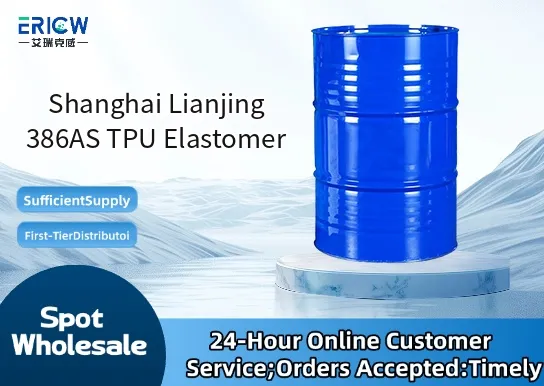
| Chemical Type | Aliphatic polyester-based thermoplastic polyurethane |
| Product Form | Pellets (free-flowing, cylindrical) |
| Appearance | Off-white to light amber, uniform granules |
| Hardness (Shore A) | 85 ± 2 |
| Melt Flow Index (210 °C/5 kg) | 12–16 g/10 min |
| Density | 1.18–1.20 g/cm³ |
| Moisture Content (as received) | ≤ 0.05 wt% |
| Key Features | Hydrolysis-resistant, UV-stabilized, non-yellowing |
Q1: What are the primary processing methods suitable for Shanghai Lianjing 386AS TPU Elastomer?
A: Shanghai Lianjing 386AS is specifically formulated for melt-processing techniques including extrusion, injection molding, and two-component (2K) thermoplastic elastomer overmolding. Its balanced melt viscosity and thermal stability support consistent flow and good surface finish across these methods.
Q2: Is 386AS compatible with common engineering thermoplastics for co-extrusion or multi-material assemblies?
A: Yes — 386AS demonstrates good interfacial adhesion with polypropylene (PP), polyethylene (PE), and ABS when processed under optimized temperature and residence time conditions. Compatibility with polycarbonate (PC) or PBT may require adhesive primers or functionalized tie layers.
Q3: How does 386AS perform in applications requiring resistance to hydrolysis and low-temperature flexibility?
A: As an aliphatic polyester-based TPU, 386AS offers inherently improved hydrolytic stability compared to aromatic TPUs, especially under warm/humid conditions. It maintains elastic recovery and impact resilience down to approximately −30 °C, making it suitable for outdoor and automotive under-hood components.
Q4: Can 386AS be used in direct-contact applications with food or skin?
A: While 386AS is manufactured using non-toxic raw materials and complies with general FDA-congruent polymer guidelines for indirect food contact, formal regulatory clearance (e.g., FDA 21 CFR or EU Plastics Regulation) requires end-product validation by the compounder or converter. Skin-contact suitability depends on final formulation, including additives and post-processing history.
Contact With Us:
E-mail: wangxingqiang@ericwchem.com
Have a Questions? Call Us:
Add:
Building A1, Jiete Industrial Park, Huangpu District, Guangzhou City, Guangdong Province, China