English
 Español
 tiếng việt
 русский
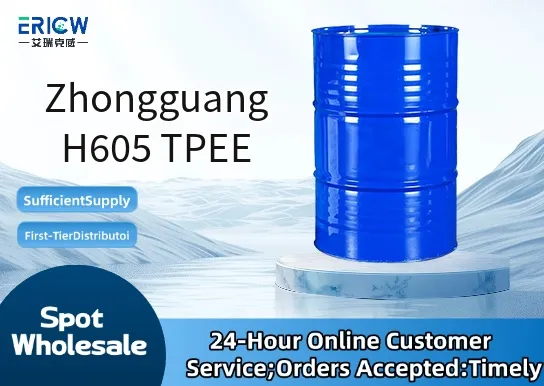
Excellent balance of thermoplastic processability and elastomeric resilience
High tensile strength and outstanding fatigue resistance at elevated temperatures
Good chemical resistance to oils, greases, and common industrial solvents
Low compression set and superior long-term elastic recovery
Easy to process via injection molding, extrusion, and blow molding without pre-drying
Automotive under-hood components including air ducts and sensor housings
Industrial drive belts and timing belt covers requiring high dimensional stability
High-performance sporting goods such as ski bindings and bicycle suspension parts
Electrical connectors and cable jacketing for demanding environmental conditions
Medical tubing and fluid-handling components compliant with ISO 10993 biocompatibility guidelines
| Chemical Type | Thermoplastic Polyester Elastomer (TPEE) |
| Product Form | Pellets |
| Appearance | Off-white to light amber, free-flowing granules |
| Density (g/cm³) | 1.24–1.27 |
| Melt Flow Rate (230°C/2.16 kg, g/10 min) | 18–22 |
| Tensile Strength at Break (MPa) | 42–48 |
| Elongation at Break (%) | 350–420 |
| Hardness (Shore D) | 60–63 |
Q1: What are the key processing advantages of Zhongguang H605 TPEE compared to conventional thermoplastic elastomers?
A: Zhongguang H605 TPEE offers excellent melt processability with low viscosity at typical extrusion and injection molding temperatures, enabling good flow into complex molds and reduced cycle times. Its fast crystallization kinetics support efficient solidification and high productivity in continuous operations.
Q2: Is Zhongguang H605 TPEE suitable for applications requiring resistance to oils and hydrocarbons?
A: Yes — as a polyester-based thermoplastic elastomer, H605 TPEE exhibits inherently superior resistance to non-polar solvents, greases, and aliphatic hydrocarbons compared to many TPU or TPO grades, making it well-suited for under-hood automotive components and industrial seals exposed to lubricants.
Q3: Can Zhongguang H605 TPEE be blended with other polymers to modify performance?
A: Yes — H605 TPEE is commonly used as a compatibilizer or toughening agent in blends with rigid thermoplastics such as PBT or PET. It can also be compounded with fillers, reinforcing fibers, or other elastomers to tailor modulus, elasticity, and thermal stability for specific end-use requirements.
Q4: What are the recommended drying conditions prior to processing?
A: To ensure optimal mechanical properties and surface quality, Zhongguang H605 TPEE should be dried thoroughly before processing. A typical recommendation is 4–6 hours at 100–110 °C using a dehumidifying dryer, with residual moisture maintained below 50 ppm.
Contact With Us:
E-mail: wangxingqiang@ericwchem.com
Have a Questions? Call Us:
Add:
Building A1, Jiete Industrial Park, Huangpu District, Guangzhou City, Guangdong Province, China