English
 Español
 tiếng việt
 русский
High reactivity with hydroxyl-terminated polyols for rapid gelation and efficient crosslinking.
Excellent compatibility with aromatic and aliphatic polyurethane systems.
Low viscosity formulation enabling easy metering, mixing, and processing in industrial equipment.
Consistent batch-to-batch performance ensuring reliable cure kinetics and final film properties.
Optimized isocyanate functionality for balanced hardness, flexibility, and chemical resistance in cured films.
Automotive clearcoats and basecoats requiring high gloss and durability.
Industrial maintenance coatings for metal and concrete substrates.
Flexible packaging adhesives demanding excellent bond strength and solvent resistance.
Roller coating systems for wood and metal decorative finishes.
Two-component polyurethane sealants and elastomeric joint fillers.
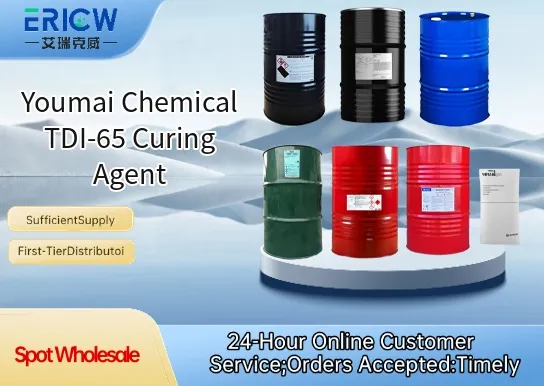
| Chemical Type | Aromatic diisocyanate-based curing agent (TDI trimer) |
| Product Form | Liquid |
| Appearance | Clear to pale yellow transparent liquid |
| NCO Content (wt%) | 12.0–13.5% |
| Viscosity (mPa·s, 25°C) | 800–1,200 |
| Density (g/cm³, 25°C) | 1.18–1.22 |
| Flash Point (°C, closed cup) | 195–205 |
| Storage Stability | ≥12 months in unopened original container at 15–25°C |
Q1: What is the primary chemical nature of TDI-65 Curing Agent?
A: TDI-65 is a polyisocyanate-based curing agent derived from toluene diisocyanate (TDI), modified to provide improved handling characteristics and controlled reactivity compared to unmodified TDI prepolymers. It functions as an active crosslinker for hydroxyl-terminated resins such as polyesters and polyethers.
Q2: How should TDI-65 be stored and handled to maintain stability?
A: Store in tightly sealed containers under dry, cool conditions (below 30°C) and protect from moisture, direct sunlight, and ambient humidity. Due to its isocyanate functionality, it reacts readily with water—therefore, strict moisture control during handling and dispensing is essential to prevent gelation or CO₂ formation.
Q3: Which resin systems is TDI-65 most commonly used with?
A: TDI-65 is widely compatible with hydroxyl-functional acrylics, polyester polyols, and polyether polyols—particularly in high-performance coating, adhesive, and elastomer formulations where enhanced hardness, chemical resistance, and moderate pot life are required.
Q4: Does TDI-65 require catalysts for optimal cure performance?
A: While TDI-65 exhibits inherent reactivity at ambient and elevated temperatures, tin-based catalysts (e.g., dibutyltin dilaurate) or tertiary amines may be added to accelerate gel time and improve through-cure—especially in thick-film or low-temperature applications. Catalyst selection and dosage depend on the specific formulation and processing conditions.
Contact With Us:
E-mail: wangxingqiang@ericwchem.com
Have a Questions? Call Us:
Add:
Building A1, Jiete Industrial Park, Huangpu District, Guangzhou City, Guangdong Province, China