English
 Español
 tiếng việt
 русский
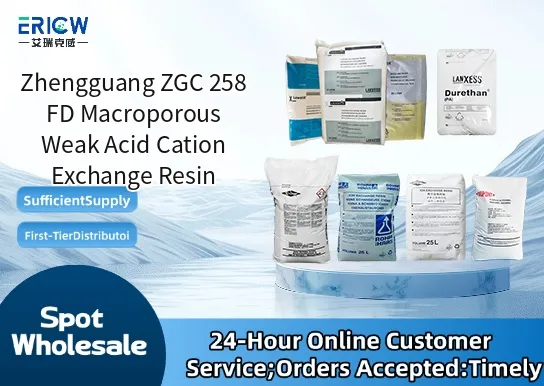
Macroporous structure ensures excellent kinetic performance and high resistance to fouling from organic contaminants.
Weak acid functional group (carboxylic acid) provides high selectivity for divalent cations (e.g., Ca²⁺, Mg²⁺) with superior regeneration efficiency using low-concentration acid.
High physical and chemical stability across broad pH range (1–14), suitable for demanding industrial service conditions.
Uniform spherical bead morphology enhances bed hydraulics, minimizes pressure drop, and improves column utilization.
Low sodium leakage and high exchange capacity (>1000 meq/L in H⁺ form) ensure reliable softening and demineralization performance.
Hardness removal and decarbonation in pretreatment for boiler feedwater and ultrapure water systems.
Recovery of valuable metal ions (e.g., Ni²⁺, Co²⁺, Cu²⁺) from electroplating rinse waters and mining leachates.
Softening of high-alkalinity municipal and industrial wastewater prior to membrane filtration or biological treatment.
Catalyst support and pH adjustment in fine chemical synthesis and pharmaceutical intermediate purification.
Removal of heavy metals from food-grade process streams, including sugar decolorization and organic acid recovery.
| Chemical Type | Macroporous weak acid cation exchange resin (carboxylic acid functional group) |
| Product Form | Moist, spherical beads |
| Appearance | Off-white to light amber, uniform spherical particles |
| Functional Group | –CH₂–COOH |
| Ion Form | H⁺ (standard supply form) |
| Total Exchange Capacity | ≥ 10.5 mmol/g (dry basis) / ≥ 1000 meq/L (wet volume) |
| Particle Size Range | 0.4 – 1.25 mm (≥ 95% retained on 12/60 mesh) |
| Moisture Content | 45 – 55% (as shipped) |
Q1: What distinguishes ZGC 258 FD from conventional gel-type weak acid cation resins?
A: ZGC 258 FD features a macroporous structure, providing superior mechanical stability, faster ion exchange kinetics, and enhanced resistance to organic fouling compared to gel-type weak acid resins—especially beneficial in feedwaters with variable or elevated suspended solids or oxidants.
Q2: Which functional group is used in this resin, and what is its primary ion exchange behavior?
A: It carries carboxylic acid (–COOH) functional groups, exhibiting high selectivity for divalent cations (e.g., Ca²⁺, Mg²⁺) over monovalent ions (e.g., Na⁺, K⁺) in the hydrogen or sodium form, with optimal performance near neutral to slightly alkaline pH.
Q3: Can ZGC 258 FD be used in demineralization systems alongside strong acid cation resins?
A: Yes—it is commonly deployed in split-bed or layered-bed configurations upstream of strong acid cation units to selectively remove hardness ions with low regenerant consumption, thereby extending the service life and improving the efficiency of downstream polishing stages.
Q4: How does the macroporous architecture affect regeneration efficiency and chemical resistance?
A: The well-defined pore structure enables more uniform acid diffusion during regeneration, supports consistent capacity recovery, and improves tolerance to chlorine and other oxidizing agents typically encountered in pretreated industrial water streams.
Contact With Us:
E-mail: wangxingqiang@ericwchem.com
Have a Questions? Call Us:
Add:
Building A1, Jiete Industrial Park, Huangpu District, Guangzhou City, Guangdong Province, China