English
 Español
 tiếng việt
 русский
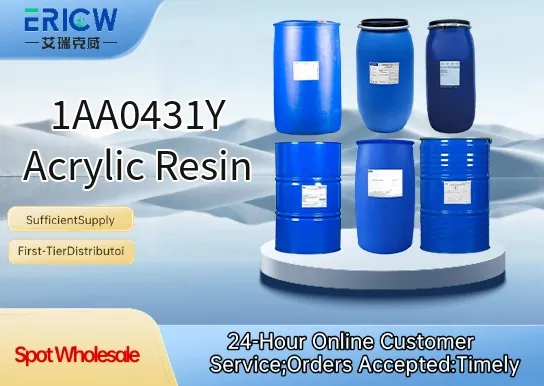
High transparency and excellent UV resistance for long-term outdoor durability.
Low viscosity in solution, enabling easy handling and compatibility with common coating solvents.
Good adhesion to diverse substrates including metals, plastics, and primed wood.
Fast air-drying characteristics with balanced film formation and solvent release.
Chemically stable backbone providing resistance to mild alkalis and dilute acids.
Automotive refinish clearcoats and basecoat binders.
Industrial maintenance coatings for metal equipment and infrastructure.
Architectural acrylic topcoats for aluminum composite panels (ACP) and extruded profiles.
Plastic substrate coatings for consumer electronics housings and automotive interior trim.
UV-curable hybrid systems as a reactive diluent and film-forming co-resin.
| Chemical Type | Acrylic copolymer (methyl methacrylate / butyl acrylate / methacrylic acid) |
| Product Form | Liquid resin in aromatic hydrocarbon solvent blend |
| Appearance | Clear, colorless to pale yellow liquid |
| Non-Volatile Content (wt%) | 50.0 ± 1.5% |
| Viscosity (25°C, mPa·s) | 800–1,200 (Brookfield RV, spindle #3, 20 rpm) |
| Acid Value (mg KOH/g) | 18–22 |
| Primary Applications | High-gloss protective topcoats, clear finishes, and crosslinkable binder systems |
| Key Features | UV stability, substrate versatility, low VOC formulation potential |
Q1: What is the primary function of 1AA0431Y Acrylic Resin in coating formulations?
A: 1AA0431Y Acrylic Resin serves as a film-forming binder and rheology modifier, enhancing gloss, scrub resistance, and substrate adhesion in waterborne architectural and industrial coatings.
Q2: Is 1AA0431Y compatible with common co-binders and additives used in acrylic emulsion systems?
A: Yes — it demonstrates broad compatibility with standard acrylic and vinyl acetate-based emulsions, defoamers, dispersants, and biocides, though compatibility testing under specific formulation conditions is recommended prior to full-scale use.
Q3: How should 1AA0431Y be incorporated into a formulation to ensure optimal performance?
A: It is typically added during the let-down stage under moderate agitation. Pre-dilution with water or formulation water phase is advised to avoid localized viscosity spikes and ensure uniform dispersion.
Q4: Does 1AA0431Y contribute to VOC reduction in finished coatings?
A: Yes — as a water-dispersible acrylic resin, it supports low-VOC and zero-VOC formulation strategies by replacing solvent-based binders and reducing or eliminating the need for organic coalescing agents.
Contact With Us:
E-mail: wangxingqiang@ericwchem.com
Have a Questions? Call Us:
Add:
Building A1, Jiete Industrial Park, Huangpu District, Guangzhou City, Guangdong Province, China