English
 Español
 tiếng việt
 русский
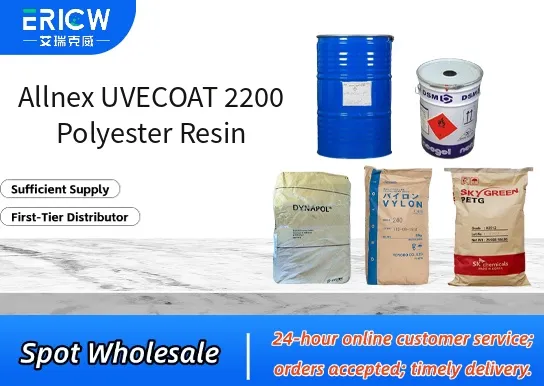
High reactivity in UV-curable coating systems for rapid through-cure and excellent surface hardness.
Low viscosity enables formulation of high-solids, low-VOC, or solvent-free UV coatings without diluents.
Excellent compatibility with common acrylate monomers and photoinitiators used in industrial UV curing.
Delivers outstanding chemical resistance, mar resistance, and gloss retention after cure.
Designed for ambient-temperature free-radical UV polymerization—no thermal post-cure required.
UV-curable clearcoats for wood flooring and furniture finishes.
Protective topcoats for plastic substrates in automotive interior trim.
High-performance overprint varnishes for flexible packaging and label printing.
UV-curable coatings for metal decorative panels and appliance housings.
Industrial maintenance coatings requiring fast line speeds and low-energy curing.
| Chemical Type | Unsaturated aliphatic polyester acrylate |
| Product Form | Viscous liquid |
| Appearance | Pale yellow to water-white, transparent |
| Primary Applications | UV-curable protective and decorative coatings |
| Key Features | Low VOC, high reactivity, excellent film flexibility |
| Benefits | Energy-efficient curing, reduced emissions, superior scratch resistance |
| Storage Stability | Stable at 25°C for ≥12 months under inert atmosphere |
| Recommended Photoinitiator Range | 3–8 wt% (e.g., TPO, 1173, or ITX) |
Q1: What is the primary application of UVECOAT 2200 in UV-curable systems?
A: UVECOAT 2200 is a low-viscosity, trifunctional polyester acrylate resin designed primarily as a reactive diluent and film-forming binder in UV-curable coatings for industrial wood, plastic, and metal substrates—especially where high hardness, chemical resistance, and rapid through-cure are required.
Q2: How does UVECOAT 2200 compare to epoxy acrylates in terms of flexibility and yellowing resistance?
A: Compared to standard epoxy acrylates, UVECOAT 2200 offers improved flexibility and significantly reduced tendency to yellow upon aging or UV exposure, making it well-suited for clear topcoats and applications demanding long-term gloss and color stability.
Q3: Is UVECOAT 2200 compatible with common photoinitiators used in free-radical UV curing?
A: Yes, UVECOAT 2200 demonstrates broad compatibility with standard free-radical photoinitiators—including benzophenone derivatives, α-hydroxy ketones, and phosphine oxides—and performs well across typical UV-A and UV-LED wavelength ranges.
Q4: Can UVECOAT 2200 be blended with other acrylate resins to tailor performance?
A: Yes, UVECOAT 2200 is fully miscible with most common acrylate monomers and oligomers—including urethane acrylates, epoxy acrylates, and other polyester acrylates—allowing formulators to balance reactivity, hardness, adhesion, and flexibility within a single system.
Contact With Us:
E-mail: wangxingqiang@ericwchem.com
Have a Questions? Call Us:
Add:
Building A1, Jiete Industrial Park, Huangpu District, Guangzhou City, Guangdong Province, China