English
 Español
 tiếng việt
 русский
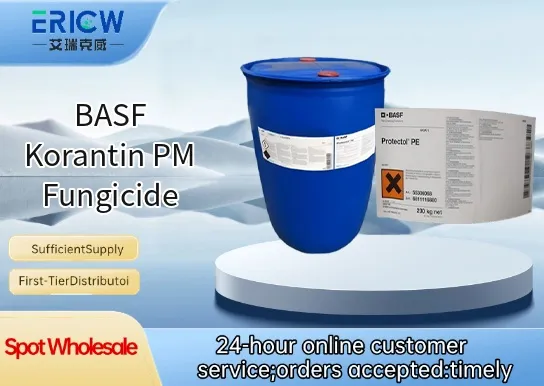
Proprietary premix formulation combining pyraclostrobin and boscalid for broad-spectrum, dual-site-of-action fungicidal activity.
Excellent preventive and curative efficacy against key foliar and fruit diseases including powdery mildew, botrytis, and anthracnose.
Enhanced rainfastness and residual protection due to optimized particle size distribution and formulation stability.
Compatible with integrated pest management (IPM) programs and supports resistance management strategies.
Low phytotoxicity profile on sensitive crops when applied at recommended rates and growth stages.
Vineyards — control of *Erysiphe necator* (powdery mildew) and *Botrytis cinerea* (gray mold).
Strawberry production — management of *Botrytis cinerea*, *Colletotrichum acutatum*, and *Podosphaera aphanis*.
Tree fruit orchards (apple, pear, peach) — suppression of scab, brown rot, and powdery mildew.
Vegetable crops (cucumber, tomato, pepper) — protection against downy mildew, early blight, and powdery mildew.
| Chemical Type | Strobilurin + SDHI fungicide premix (pyraclostrobin + boscalid) |
| Product Form | Flowable concentrate (SC) |
| Appearance | Brownish-gray suspension, homogeneous liquid |
| Active Ingredient Content | 200 g/L pyraclostrobin + 200 g/L boscalid |
| pH Range (1% aqueous solution) | 6.0 – 7.5 |
| Density (20°C) | 1.18 – 1.22 g/cm³ |
| Storage Stability | ≥ 24 months in unopened original container at 5–30°C |
| Primary Applications | Foliar spray for high-value horticultural crops |
Q1: What is the primary mode of action of Korantin PM Fungicide?
A: Korantin PM is a multi-site contact fungicide with protective activity, acting primarily through inhibition of fungal spore germination and mycelial growth on plant surfaces. Its broad-spectrum efficacy stems from interference with essential cellular processes in sensitive pathogens.
Q2: Which crop types and disease spectra is Korantin PM typically registered for?
A: Korantin PM is widely used in field and horticultural crops—including cereals, potatoes, grapes, and vegetables—against key foliar diseases such as early blight, late blight, powdery mildew, and various leaf spots caused by Botrytis, Alternaria, and Septoria species. Registration status varies by country and must be verified locally.
Q3: Can Korantin PM be tank-mixed with other agrochemicals?
A: Yes, Korantin PM generally exhibits good physical and chemical compatibility with many commonly used fungicides, insecticides, and foliar nutrients. However, always conduct a jar test prior to large-scale tank mixing and consult the latest BASF compatibility guidelines or local technical support for specific combinations.
Q4: What are the key handling and safety considerations during application?
A: As with all professional fungicides, appropriate personal protective equipment (PPE) including gloves, goggles, and respiratory protection should be worn during handling and spraying. Avoid inhalation of dust or spray mist, and prevent environmental release—especially into water bodies—due to potential toxicity to aquatic organisms.
Contact With Us:
E-mail: wangxingqiang@ericwchem.com
Have a Questions? Call Us:
Add:
Building A1, Jiete Industrial Park, Huangpu District, Guangzhou City, Guangdong Province, China