English
 Español
 tiếng việt
 русский
Excellent abrasion resistance for extended service life in demanding mechanical environments.
Outstanding elasticity and recovery performance at both room and elevated temperatures.
Good oil, grease, and hydrocarbon resistance suitable for industrial fluid-contact applications.
High transparency and clarity with low inherent yellowness for optical-grade end uses.
Easy processability via extrusion, injection molding, and calendering without pre-drying.
Medical tubing and fluid delivery components requiring biocompatibility and kink resistance.
High-performance automotive interior trim and soft-touch overlays.
Flexible industrial hoses and pneumatic conveying lines.
Transparent protective films and laminating layers for electronic displays.
Wear-resistant footwear midsoles and outsole compounds.
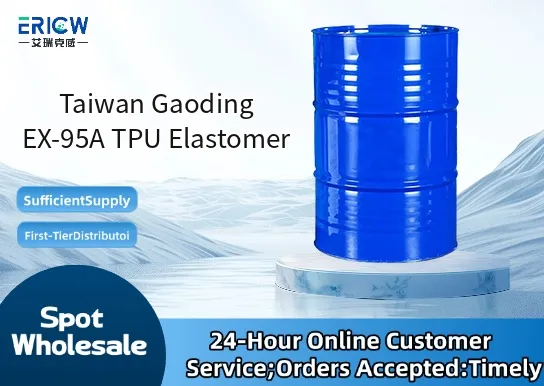
| Chemical Type | Aliphatic polyester-based thermoplastic polyurethane |
| Product Form | Pellets |
| Appearance | Translucent, off-white to light amber pellets |
| Shore A Hardness (ASTM D2240) | 95 ± 2 |
| Melt Flow Index (210°C/2.16 kg, ASTM D1238) | 12–18 g/10 min |
| Density (ASTM D792) | 1.18–1.20 g/cm³ |
| Moisture Content (ASTM D6980) | ≤ 0.05% (as received) |
| Primary Applications | Extruded tubing, molded components, transparent films, soft-touch parts |
Q1: What are the key processing advantages of EX-95A compared to conventional TPU grades?
A: EX-95A offers enhanced melt stability and lower melt viscosity during extrusion and injection molding, enabling smoother flow through fine-die profiles and improved surface finish on finished parts. Its optimized thermal profile also supports faster cycle times without compromising mechanical integrity.
Q2: Is EX-95A suitable for overmolding onto common engineering plastics like ABS or PC?
A: Yes — EX-95A demonstrates strong interfacial adhesion to a range of thermoplastics including ABS, PC, and PP when processed under appropriate temperature and dwell time conditions. Surface preparation and mold temperature control are recommended to maximize bond strength.
Q3: How does EX-95A perform in dynamic flexing applications such as cable jackets or wearable components?
A: EX-95A delivers excellent long-term flex fatigue resistance and maintains elasticity across repeated bending cycles. Its balanced hard-segment/hard-segment microstructure contributes to low hysteresis and reduced heat buildup during continuous motion.
Q4: Can EX-95A be used in medical-grade or skin-contact applications?
A: While EX-95A is formulated without known SVHCs or intentional heavy metals, it is not pre-certified for medical device or direct-skin-contact use. Customers must conduct full biocompatibility testing per ISO 10993 and validate compliance with applicable regional regulatory requirements.
Contact With Us:
E-mail: wangxingqiang@ericwchem.com
Have a Questions? Call Us:
Add:
Building A1, Jiete Industrial Park, Huangpu District, Guangzhou City, Guangdong Province, China