English
 Español
 tiếng việt
 русский
Excellent elasticity and recovery performance across a wide temperature range (−40 °C to 100 °C).
Outstanding processability via injection molding, extrusion, and overmolding onto PP, PS, and ABS substrates.
Good resistance to UV exposure, ozone, and aging without requiring additional stabilizers.
Low compression set (<25% at 70 °C for 22 h), ensuring long-term sealing and gasket integrity.
Halogen-free formulation compliant with RoHS and REACH directives for sustainable manufacturing.
Automotive interior trim components including door panels, armrests, and console covers.
Soft-touch grips and ergonomic housings for power tools and consumer electronics.
Seals, gaskets, and vibration-damping pads in industrial equipment assemblies.
Overmolded handles for household appliances such as vacuum cleaners and kitchen blenders.
Flexible connectors and protective sleeves in medical device enclosures (non-sterile contact).
| Chemical Type | Thermoplastic Elastomer (TPE) – Styrenic Block Copolymer (SBC) based |
| Product Form | Pellets |
| Appearance | Translucent off-white granules |
| Primary Applications | Overmolding, soft-touch finishing, dynamic sealing |
| Key Features | Elasticity, adhesion to rigid thermoplastics, recyclability |
| Benefits | Reduced part weight vs. rubber, faster cycle times vs. thermosets, no vulcanization required |
| Density (g/cm³) | 0.92–0.94 |
| Melt Flow Rate (g/10 min, 200 °C/5 kg) | 15–25 |
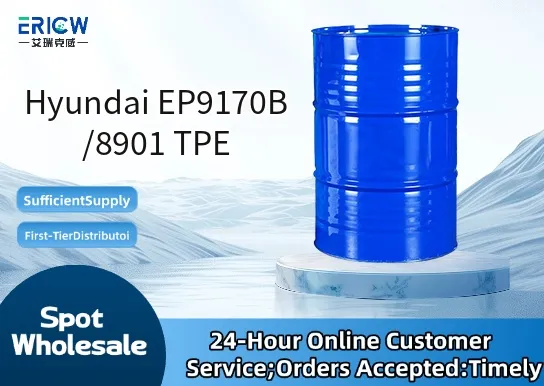
Q1: What is the primary functional role of Hyundai EP9170B/8901 TPE in polymer formulations?
A: Hyundai EP9170B/8901 TPE is a thermoplastic elastomer designed primarily as a compatibilizer and impact modifier—especially in polyolefin-based blends. It enhances interfacial adhesion between immiscible phases and improves toughness without significantly compromising melt processability.
Q2: Is this grade suitable for applications requiring repeated flexing or dynamic mechanical stress?
A: Yes—EP9170B/8901 TPE exhibits excellent elastic recovery and fatigue resistance due to its balanced soft-segment/hard-segment microstructure. It is commonly selected for components subjected to cyclic bending, such as seals, gaskets, and overmolded grips.
Q3: How does processing temperature affect the performance consistency of this TPE?
A: Optimal processing occurs within a moderate thermal window—typically between 160 °C and 200 °C. Excessive residence time or temperatures above 210 °C may lead to partial degradation of the elastomeric phase, resulting in reduced elasticity and surface quality. Consistent melt temperature control is recommended for reproducible mechanical properties.
Q4: Can EP9170B/8901 TPE be used in direct contact with food-contact polymers?
A: While EP9170B/8901 TPE is formulated without intentionally added heavy metals or known endocrine disruptors, it is not pre-certified for food-contact applications. Regulatory compliance must be verified case-by-case through full formulation testing and relevant jurisdictional assessments.
Contact With Us:
E-mail: wangxingqiang@ericwchem.com
Have a Questions? Call Us:
Add:
Building A1, Jiete Industrial Park, Huangpu District, Guangzhou City, Guangdong Province, China