English
 Español
 tiếng việt
 русский
Outstanding low-temperature flexibility and impact resistance down to –60 °C
Excellent melt processability for high-speed extrusion and injection molding
Superior compatibility with polypropylene (PP) and polyethylene (PE) for blend modification
Low density (0.870–0.875 g/cm³) enabling lightweight part design
Good UV stability and long-term weathering resistance without additional stabilizers
Automotive interior trim components including door panels and instrument bezels
Toughened polypropylene (PP) compounds for under-hood applications
Soft-touch overmolding on rigid substrates in consumer electronics housings
Flexible packaging films requiring seal integrity and puncture resistance
Medical tubing and connectors requiring biocompatibility and kink resistance
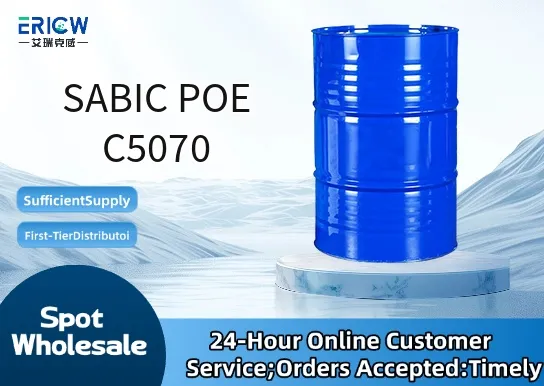
| Chemical Type | Polyolefin Elastomer (POE), ethylene-octene copolymer |
| Product Form | Natural pellets, free-flowing |
| Appearance | Off-white, translucent granules |
| Primary Applications | Thermoplastic elastomer (TPE) modifier, PP/PE impact modifier, soft-touch material |
| Key Features | High elasticity, excellent clarity, low extractables |
| Benefits | Enhanced toughness without sacrificing stiffness; recyclable within polyolefin streams |
| Density (ASTM D792) | 0.872 ± 0.003 g/cm³ |
| Melt Flow Rate (190 °C/2.16 kg, ASTM D1238) | 1.0 ± 0.3 g/10 min |
Q1: What is the primary function of SABIC POE C5070 in polymer blends?
A: SABIC POE C5070 is an ethylene-octene polyolefin elastomer designed primarily as a toughening agent and impact modifier—especially for rigid polypropylene (PP) and polyethylene (PE) systems—enhancing ductility, low-temperature impact resistance, and melt processability without significantly compromising stiffness.
Q2: Is SABIC POE C5070 suitable for use in food-contact applications?
A: SABIC POE C5070 is manufactured to meet general-purpose polymer purity requirements and is commonly used in food-contact packaging where regulatory compliance is supported by appropriate formulation controls and end-product testing. Customers must verify suitability against applicable regional regulations and conduct full migration and safety assessments as part of their own compliance process.
Q3: How does SABIC POE C5070 compare to EPDM or EPR in PP modification?
A: Unlike traditional EPDM or EPR elastomers, SABIC POE C5070 offers superior compatibility with polypropylene due to its saturated backbone and narrow molecular weight distribution, resulting in more consistent dispersion, improved long-term thermal stability, and reduced risk of crosslinking during processing. It also typically delivers better clarity and lower gel content in finished compounds.
Q4: What processing methods are recommended for SABIC POE C5070?
A: SABIC POE C5070 is well-suited for conventional thermoplastic processing techniques including injection molding, extrusion, and blow molding. Its low melt viscosity and excellent thermal stability allow for efficient blending with PP or PE matrices using standard twin-screw extruders—typically without requiring specialized equipment or major process adjustments.
Contact With Us:
E-mail: wangxingqiang@ericwchem.com
Have a Questions? Call Us:
Add:
Building A1, Jiete Industrial Park, Huangpu District, Guangzhou City, Guangdong Province, China