English
 Español
 tiếng việt
 русский
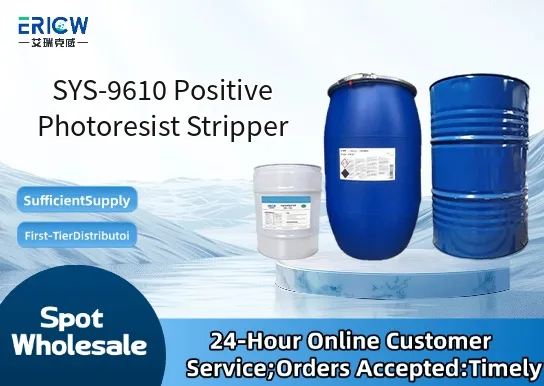
Fast and complete removal of standard g-line, i-line, and deep UV (DUV) positive photoresists without damaging underlying metal or dielectric layers.
Low volatility and high thermal stability enable consistent performance in both batch and spray-in-air stripping systems.
Non-halogenated, sulfur-free formulation meets stringent environmental and workplace safety requirements.
Low surface tension and excellent wetting properties ensure uniform coverage on high-aspect-ratio patterns and complex topographies.
Compatible with automated dispensing and closed-loop recycling systems for reduced chemical consumption and waste generation.
Semiconductor front-end-of-line (FEOL) and back-end-of-line (BEOL) photolithography process residue removal.
MEMS and microfabrication processes requiring gentle yet effective resist stripping on silicon, SiO₂, SiNₓ, and Al/Cu metallization.
Advanced packaging applications including fan-out wafer-level packaging (FOWLP) and redistribution layer (RDL) processing.
Flat panel display (FPD) manufacturing for TFT array cleaning and color filter alignment layer residue removal.
Compound semiconductor fabrication (GaAs, GaN, SiC) where halogen-free chemistry is critical to prevent device contamination.
| Chemical Type | Organic solvent-based, non-oxidizing formulation |
| Product Form | Liquid (ready-to-use) |
| Appearance | Clear, pale yellow liquid, free of suspended solids |
| Primary Applications | Stripping of novolac- and chemically amplified positive photoresists |
| Key Features | Non-corrosive to aluminum, copper, titanium, and low-k dielectrics |
| Benefits | Reduced particle generation, minimal undercut, and high selectivity vs. etch-stop layers |
| Regulatory Compliance | REACH SVHC-free; compliant with OSHA HCS 2012 and GHS labeling standards |
| Storage Stability | ≥24 months unopened at 15–25°C; no phase separation or precipitation observed |
| Common Compatible Systems | Suitability |
| SEZ A300 / A400 Spray Rinse Systems | Highly Recommended – Optimized for nozzle flow rate, temperature ramp, and dwell time |
| Modutek Teflon®-lined Batch Tanks (Model S-200 series) | Recommended – Requires agitation control and temperature setpoint of 65–75°C |
| Screen Semi Dainippon Screen (DNS) STI Series | Highly Recommended – Fully validated for inline processing with integrated DI rinse and dry modules |
| Technics etch & strip tools (e.g., TS-8000 platform) | Suitable – Compatible with standard PTFE fluid paths; verify pump seal material compatibility |
Q1: What is the CAS Registry Number for SYS-9610?
A: The CAS Registry Number for SYS-9610 Positive Photoresist Stripper is 1824857-93-8.
Q2: What is the recommended process temperature and immersion time for optimal stripping?
A: For batch immersion, use 70 ± 2°C for 3–6 minutes; for spray systems, maintain substrate temperature at 65–75°C with 90–150 seconds dwell time under continuous spray.
Q3: How does SYS-9610 compare to traditional NMP-based strippers in terms of safety and performance?
A: SYS-9610 eliminates reproductive toxicity concerns associated with NMP (CAS 872-50-4), offers lower vapor pressure (<0.1 mmHg at 20°C), and delivers comparable or superior stripping rates with significantly reduced undercut on sub-100 nm features.
Q4: Is SYS-9610 certified for use in ISO 14644-1 Class 1 cleanrooms?
A: Yes — SYS-9610 is manufactured and filtered to ≤0.05 µm particulate specification and tested per IEST-G-CC1001; certificate of conformance available upon request.
Q5: Has migration or extractables testing been performed for use with copper/low-k interconnect stacks?
A: Yes — ICP-MS analysis confirms <0.1 ppb residual metal leaching (Cu, Ta, Ti) after full process cycle; no detectable organic extractables above 1 ppm by GC-MS per JEDEC JESD22-A109.
Contact With Us:
E-mail: wangxingqiang@ericwchem.com
Have a Questions? Call Us:
Add:
Building A1, Jiete Industrial Park, Huangpu District, Guangzhou City, Guangdong Province, China