English
 Español
 tiếng việt
 русский
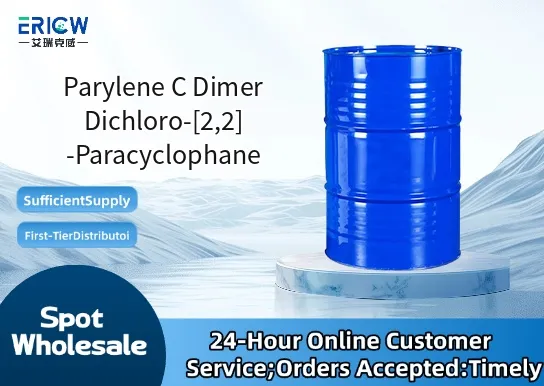
High-purity dimer precursor enabling uniform, pinhole-free Parylene C polymer coatings via vapor deposition.
Enhanced moisture and chemical resistance compared to Parylene N due to chlorine substitution on the aromatic ring.
Thermally stable crystalline solid with consistent sublimation behavior under controlled CVD process conditions.
Low residual monomer content (<0.5% w/w), minimizing post-deposition outgassing and film stress.
Controlled molecular weight distribution ensures reproducible pyrolysis kinetics and film thickness predictability.
Conformal protective coating for implantable medical devices including pacemaker leads, neurostimulators, and sensor electrodes.
Moisture barrier layer in MEMS packaging and high-reliability aerospace electronics.
Corrosion-resistant encapsulation for printed circuit boards (PCBs) operating in harsh industrial environments.
Dielectric isolation for microfluidic chips and lab-on-a-chip platforms requiring biocompatibility and solvent resistance.
Surface functionalization primer for adhesion promotion between Parylene C films and underlying substrates (e.g., silicon, stainless steel, polyimide).
| Chemical Type | Dichloro-substituted [2.2]paracyclophane dimer |
| Product Form | Crystalline powder |
| Appearance | White to off-white free-flowing crystals |
| Melting Point | 268–272 °C (determined by DSC, onset) |
| Primary Applications | Precursor for Parylene C vapor deposition (CVD) |
| Key Features | High purity (≥99.5% by GC), low chloride ion residue, low volatility impurities |
| Benefits | Enables high-yield, low-defect Parylene C film formation; supports ISO 10993-compliant processing |
| Regulatory Compliance | REACH registered; RoHS compliant; no SVHCs above threshold per EU Annex XIV |
| Common Compatible Systems | Suitability |
| SCS PDS 2010 / PDS 2020 Coating Systems | Highly Recommended – Optimized thermal profiles and chamber geometry for complete dimer sublimation and pyrolysis |
| Specialty Coating Systems (SCS) PDS 2030 / 2040 | Highly Recommended – Integrated mass flow control and cold trap compatibility ensure high monomer purity |
| Technicor Parylene Coaters (e.g., Model PC-1000) | Recommended – Requires verified temperature ramp calibration for optimal dimer feed stability |
| Custom-built CVD systems with quartz-lined dimer boat and dual-zone heating | Suitable – Must maintain ≥150 °C vapor line temperature and ≤0.1 Torr process pressure |
Q1: What is the CAS Registry Number for Parylene C Dimer Dichloro-[2,2]-Paracyclophane?
A: The CAS Number is 29847-57-4.
Q2: How much dimer is typically required to coat a standard 10 cm × 10 cm PCB with 10 µm Parylene C film?
A: Approximately 1.8–2.2 g of dimer is needed, assuming 65–75% conversion efficiency from dimer to deposited polymer under standard CVD conditions.
Q3: How does Parylene C Dimer compare to Parylene N Dimer in terms of barrier performance and processing temperature?
A: Parylene C Dimer yields a polymer with superior moisture barrier (10× lower WVTR) and higher dielectric strength than Parylene N; its sublimation onset occurs at ~130 °C, ~25 °C higher than Parylene N Dimer, requiring adjusted heater zone settings.
Q4: Is extractable chloride or residual solvent testing available for this material?
A: Yes — certified test reports include ICP-MS for chloride ion (≤5 ppm) and GC-MS for residual solvents (acetone, chlorobenzene, toluene all <10 ppm), per USP <661.1> and ISO 10993-12 protocols.
Q5: Does this dimer meet requirements for use in Class III medical device manufacturing under FDA 21 CFR Part 820?
A: Yes — supplied with full traceability, CoA (including assay, impurities, and residual metals), and documented change control; compliant with ISO 13485:2016 quality system requirements for medical device raw materials.
Contact With Us:
E-mail: wangxingqiang@ericwchem.com
Have a Questions? Call Us:
Add:
Building A1, Jiete Industrial Park, Huangpu District, Guangzhou City, Guangdong Province, China