English
 Español
 tiếng việt
 русский
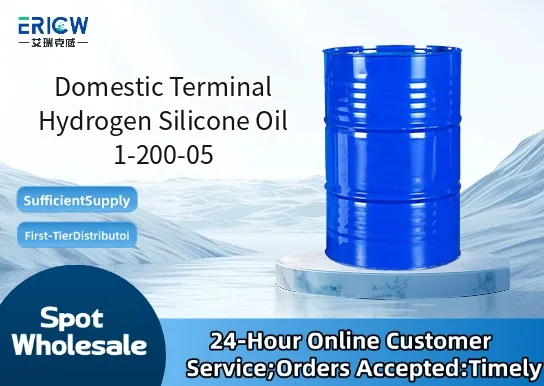
Terminal hydrogen-functional silicone fluid offering controlled reactivity for precise hydrosilylation crosslinking.
Low volatility and excellent thermal stability up to 200 °C in inert atmospheres.
High purity with minimal cyclic siloxane (D4–D6) content, supporting regulatory compliance for sensitive applications.
Clear, colorless to pale yellow liquid with consistent viscosity and batch-to-batch reproducibility.
Hydrogen content optimized for efficient Pt-catalyzed addition reactions without excessive gas evolution.
Formulation of heat-curable liquid silicone rubber (LSR) for medical device components and infant care products.
Crosslinker in high-performance silicone release coatings for food-grade packaging papers and films.
Functional additive in specialty adhesives requiring enhanced substrate adhesion and thermal resistance.
Base fluid for platinum-cured optical encapsulants used in LED lighting and sensor protection.
Reactive diluent in silicone-based conformal coatings for electronics protection under demanding environmental conditions.
| Chemical Type | Hydrogen-terminated polydimethylsiloxane (H-PDMS) |
| Product Form | Clear, low-viscosity liquid |
| Appearance | Colorless to faintly yellow, transparent, homogeneous |
| Hydrogen Content (wt%) | 0.12 – 0.18% |
| Viscosity @ 25 °C (cSt) | 180 – 220 |
| Refractive Index @ 25 °C | 1.400 – 1.405 |
| Density @ 25 °C (g/cm³) | 0.970 – 0.985 |
| Regulatory Compliance | Meets USP <87>/<88> Class VI biocompatibility requirements; compliant with REACH SVHC candidate list (no substances above 0.1% w/w) |
| Common Compatible Systems | Suitability |
| Pt-Catalyzed LSR Formulations (e.g., Momentive SILASTIC® LSR systems) | Highly Recommended – Fully compatible with standard Karstedt-type catalysts; enables rapid, uniform cure profiles. |
| Food-Grade Silicone Release Coating Systems (e.g., Wacker ELASTOSIL® LR 3043) | Recommended – Effective crosslink density enhancement; validated for FDA 21 CFR 175.300 compliance when formulated per guidelines. |
| High-Temperature Adhesive Primers (e.g., Dow Corning® 1-2577) | Suitable – Improves interfacial bonding on metals and ceramics; requires optimization of H:Si ratio during compounding. |
| Optical Encapsulant Blends (e.g., Shin-Etsu KE-1070 series) | Recommended – Enhances refractive index matching and long-term UV stability without yellowing. |
Q1: What is the CAS Registry Number for Domestic Terminal Hydrogen Silicone Oil 1-200-05?
A: The CAS number is 63148-62-9 (generic for hydrogen-terminated PDMS fluids within this molecular weight range); exact batch-specific verification is available upon request with CoA.
Q2: What is the recommended dosage level when used as a crosslinker in LSR formulations?
A: Typical usage is 0.5–2.5 phr (parts per hundred rubber), adjusted to achieve target H:Si molar ratio of 1.1–1.5:1 relative to vinyl-functional polymer; precise dosing requires stoichiometric calculation based on measured vinyl content.
Q3: How does Domestic Terminal Hydrogen Silicone Oil 1-200-05 differ from linear methylhydrosiloxane-dimethylsiloxane copolymers (e.g., HMDZ)?
A: Unlike HMDZ, which contains internal Si–H groups, 1-200-05 features exclusive terminal Si–H functionality—enabling higher crosslink efficiency, reduced side reactions (e.g., dehydrogenative coupling), and superior network homogeneity in final cured products.
Q4: Is migration or extractable hydrogen observed in food-contact applications?
A: When fully cured per validated time/temperature protocols (e.g., 150 °C × 10 min), residual extractables—including unreacted Si–H—are below detectable limits (<0.1 ppm) per EU Regulation 10/2011 and FDA 21 CFR 177.2600 testing protocols.
Contact With Us:
E-mail: wangxingqiang@ericwchem.com
Have a Questions? Call Us:
Add:
Building A1, Jiete Industrial Park, Huangpu District, Guangzhou City, Guangdong Province, China